

(And by “standard”, we do not mean software. We mean a repeatable way of working — the same calm steps your team follows, even on a tired Tuesday.)
Most owners think growth needs more talent.
A “better team”. More hustle. More heroics.
The more hopeful truth: you can win with ordinary people if your business has a clear standard.
W. Edwards Deming said it bluntly: “A bad system will beat a good person every time.”
In plain English: if your way of working is messy, even great people will struggle. If your way of working is clear, average teams become excellent.
TL;DR (scroll version)
- Talent is great, but consistency scales.
- Standards build trust (and trust drives renewals and referrals).
- Start with 3 standards: Response, First 2 Weeks, Change.
Why standards work (quick proof from other industries)
In healthcare, checklists are not “admin”. They are a safety tool. And the results are measurable.
- In the Michigan ICU “Keystone” work, a simple checklist-based intervention reduced the median catheter-related bloodstream infection rate from 2.7 per 1000 catheter-days to 0 after implementation.
- The WHO surgical safety checklist program was linked with fewer surgical complications and deaths across hospitals in different countries.
Different world than children’s activities — same lesson: simple standards reduce uncertainty, mistakes, and stress.
How to apply this in children’s activities and education
You don’t need a thick manual. You need three standards that parents feel immediately.
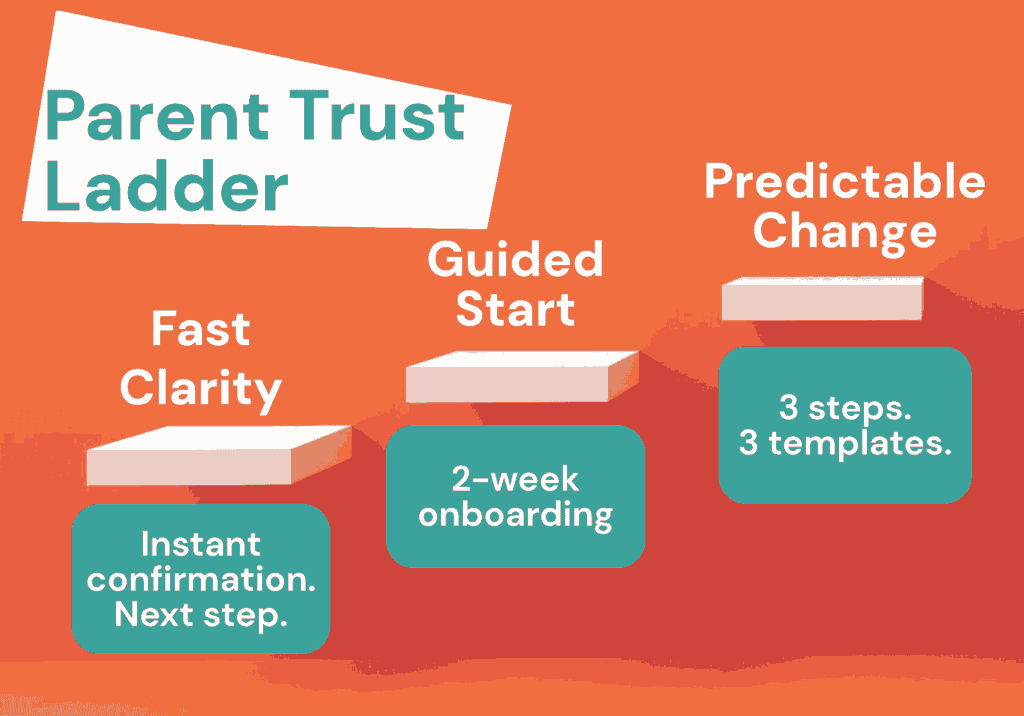
1) Response Standard: speed + clarity (especially after midnight)
Parents often do planning and purchases late at night, when the house is finally quiet. That makes time a real competitive advantage.
The standard: when something happens, the parent gets an instant confirmation and a clear next step.
Examples:
- If someone cancels a session → they instantly get confirmation and (if your policy allows) an option to pick a make-up session.
- If someone wants to buy, pay, upgrade, or add something → they can do it anytime through their profile, without waiting for office hours.
- Access, confirmations, and choices should be immediate. No “we’ll get back to you tomorrow.”
This is not “be online 24/7”.
It’s “design the experience so parents don’t need you online”.
2) Delivery Standard: the first 2 weeks are the product
Most parents decide if they trust you in the first two weeks.
Not because of one session — but because of the feeling: “This is organised. This is safe. These people know what they’re doing.”
The standard: after someone joins, you always think 2–3 steps ahead.
A simple 2-week sequence could include:
- A short “what to expect” video
- What to bring + where to go + how arrival works
- The most common parent questions (FAQ)
- A clear “If you have questions, we’re here” message (give them a back door)
This builds trust because you answer questions before parents feel confused.
3) Change Standard: changes happen — your response should be predictable
In children’s activities, changes are normal: tutor illness, room change, schedule change, make-ups (catch-up sessions), weather, school events.
The goal is not “no changes”.
The goal is no confusion.
The standard: when anything changes, you follow the same 3 steps every time:
- Explain what changed (one clear sentence)
- Offer the next option (make-up / credit / new time)
- Confirm the plan (date, time, place, any payment impact)
Templates (the secret weapon)
Templates are part of your way of working. Not “software templates”. Just reusable messages so parents always get the same clarity.
Your 3 must-have templates:
- Session rescheduled → what changed + new time + what the parent needs to do
- Tutor changed → reassurance + what stays the same
- Make-up options → where / when / how much / what next
If your team runs changes with the same steps and the same templates, your business feels calm.
That calm becomes your brand.
The Calm Business Checklist (save this)
- Do parents get instant confirmations?
- Can they self-serve common actions (cancel, make-up choice, payment, upgrade)?
- Do new families get a clear 2-week onboarding sequence?
- Do you proactively answer the top FAQs?
- Do you have one change process your whole team follows?
- Do you have 3 simple templates ready for the most common changes?
Where Zooza fits (light mention)
You can run these standards manually.
But if you want them to happen instantly and consistently, tools like Zooza can automate confirmations, reminders, self-service actions, and change notifications — while your team keeps the human tone.
Closing
Talent helps.
But standards create reliability — and reliability is what parents pay for, stay for, and recommend.