Your Loyalty Program for Children’s Activity Business Isn’t About Discounts — It’s About the Three Moments You Keep Losing Families

You don’t build loyalty by offering discounts. You build it by protecting the exact moments when families walk out. Most children’s activity businesses have at least one of those moments completely unprotected — and they don’t even know it.
A loyalty program for a children’s activity business isn’t a marketing tactic. It’s a friction-removal system. And when you understand the difference, the math changes dramatically.
The Three Moments When Families Leave
Across dance studios, language schools, gymnastics clubs, and STEM academies, families don’t leave because they’re unhappy. They leave because something small — a hesitation, a price comparison, a missed re-enrolment window — goes unaddressed. These moments are predictable. They happen every season, at every location.
Moment 1: The unprotected referral. A parent tells a friend about your dance studio. The friend is interested but not committed. There’s no incentive to try, no reason to act now. The conversation dies. You never see that family.
Moment 2: The unprotected sibling enrolment. A parent with one child enrolled considers signing up their second. They mentally double the cost. Full price times two feels different from full price times one. Without an automatic adjustment, they hesitate — and sometimes the second child never enrols.
Moment 3: The unprotected retention moment. A family finishes their third season. Renewal has been automatic until now — habit, not decision. But this time, something shifts. Maybe the schedule changed. Maybe a competitor opened nearby. They don’t renew, and nobody notices until week three of the new term, when the slot is already filled or lost.
Challenge: Each of these moments has a natural dropout risk. Each is invisible without a system. And each one silently erodes your revenue — not in a dramatic way, but in the slow, compounding way that makes owners say, “I don’t know why numbers are down this year.”
What Research Actually Says About Loyalty Programs
The word ”loyalty” is misleading. It implies emotion — gratitude, attachment, brand love. The research says otherwise.
Frederick Reichheld’s work with Bain & Company found that a 5% increase in client retention can increase profits by 25–95%. Not because retained clients spend dramatically more per transaction, but because acquisition cost drops to near zero in year two, three, and four. Every season a family stays is a season you didn’t pay to replace them.
Kumar and Shah’s research in the Journal of Marketing (2004) goes further: loyalty programs don’t work as motivators. They work as friction removers. The discount doesn’t buy loyalty — it removes the hesitation at a critical decision point. The parent doesn’t enrol their second child because you gave them 15% off. They enrol because you removed the mental barrier that was stopping them.
And here’s the structural insight: switching cost is the real driver. A family with two children enrolled in your gymnastics club has dramatically higher switching costs than a single-child family. They’d need to find a new club that works for both kids, both schedules, both levels. That’s not emotional loyalty. That’s rational inertia — and it’s far more reliable.
The Compounding Effect: Real Numbers for 200 Families
Let’s make this concrete. Take an activity school — say a multi-location dance studio network — with 200 active families and an average annual spend of €800 per family per year.
Realistic baseline assumptions:
-
18% of families refer someone during a season
-
22% of families have a second child eligible for enrolment
-
65% of clients return each season without intervention
Without a loyalty system: Referrals happen informally — maybe 36 families mention you, but only a fraction convert (let’s say 8 new families). Sibling enrolments happen when parents remember to ask about discounts (maybe 15 of 44 eligible families). Retention sits at 65%, meaning you lose 70 families every year and must replace them.
With a structured loyalty system: Referrals are tracked and incentivised — referred families convert at 3–5x the rate of cold leads (Nielsen). Even conservatively, you convert 18–22 new families instead of 8. Sibling discounts apply automatically, raising the uptake from 15 to 30+ families. Returning client pricing triggers before re-enrolment, pushing retention from 65% to 75%.
Over 12 months, the difference is roughly €25,000–€40,000 in additional revenue for a 200-family business — with near-zero marginal cost. Most of that comes not from new money but from money you were already losing.
Solution: A three-layer loyalty system captures all three moments automatically. It doesn’t require staff memory, manual codes, or seasonal campaigns. It runs in the background, protecting revenue at every decision point where families are most likely to leave.
The Three-Layer Loyalty System in Zooza
Zooza’s approach to loyalty is built around those three moments, implemented as three configurable layers. Each can run independently or stack together.
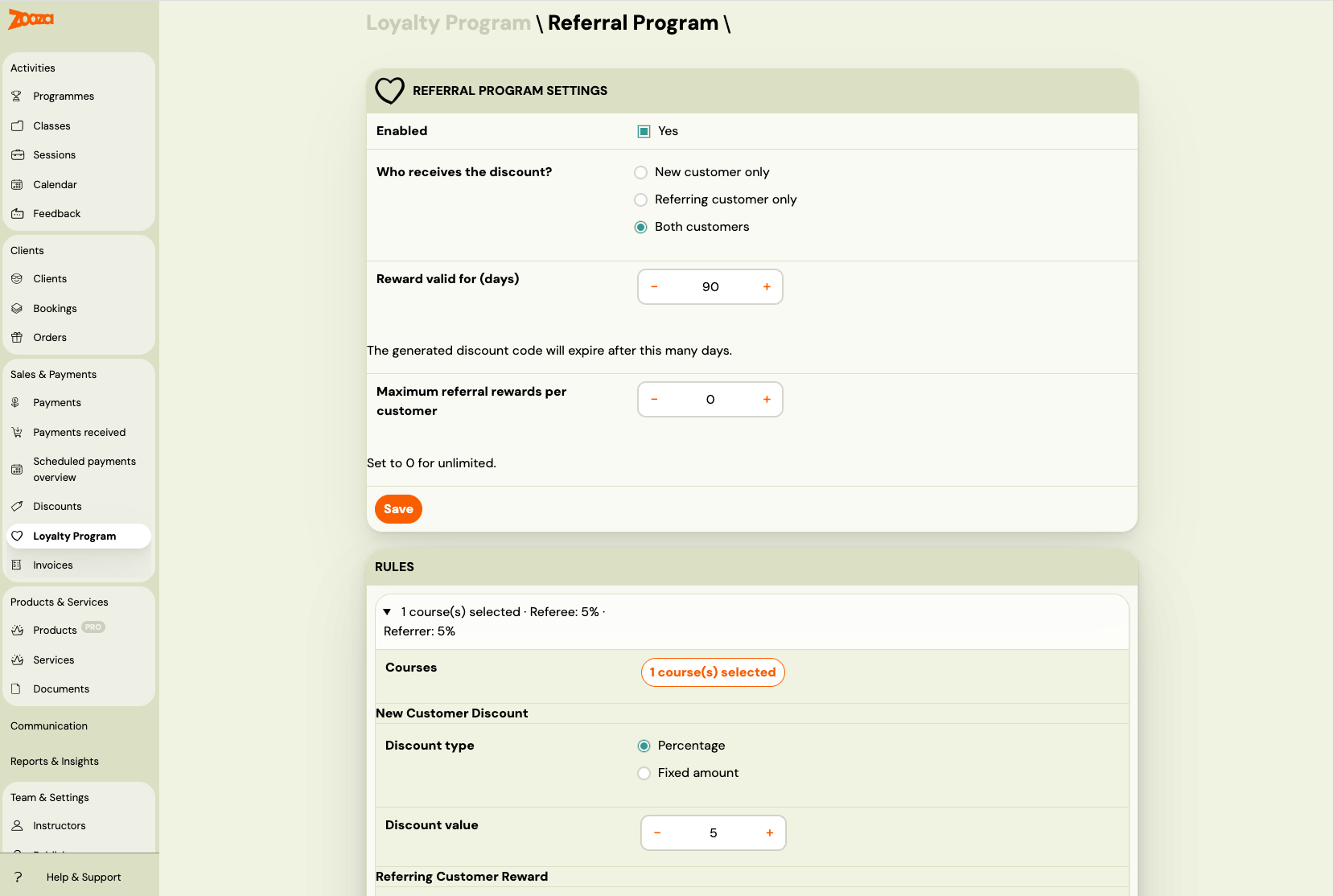
Layer 1: Referral Program
Every family gets a unique referral link. When a new family enrols through that link, both the referrer and the new client receive a configurable benefit — a discount on the next term, a credit, or a fixed amount off. No codes to remember. No staff involvement. The system tracks everything. You can explore how to set up a referral program for your activity business and learn which referral metrics actually matter.
Layer 2: Sibling Discount
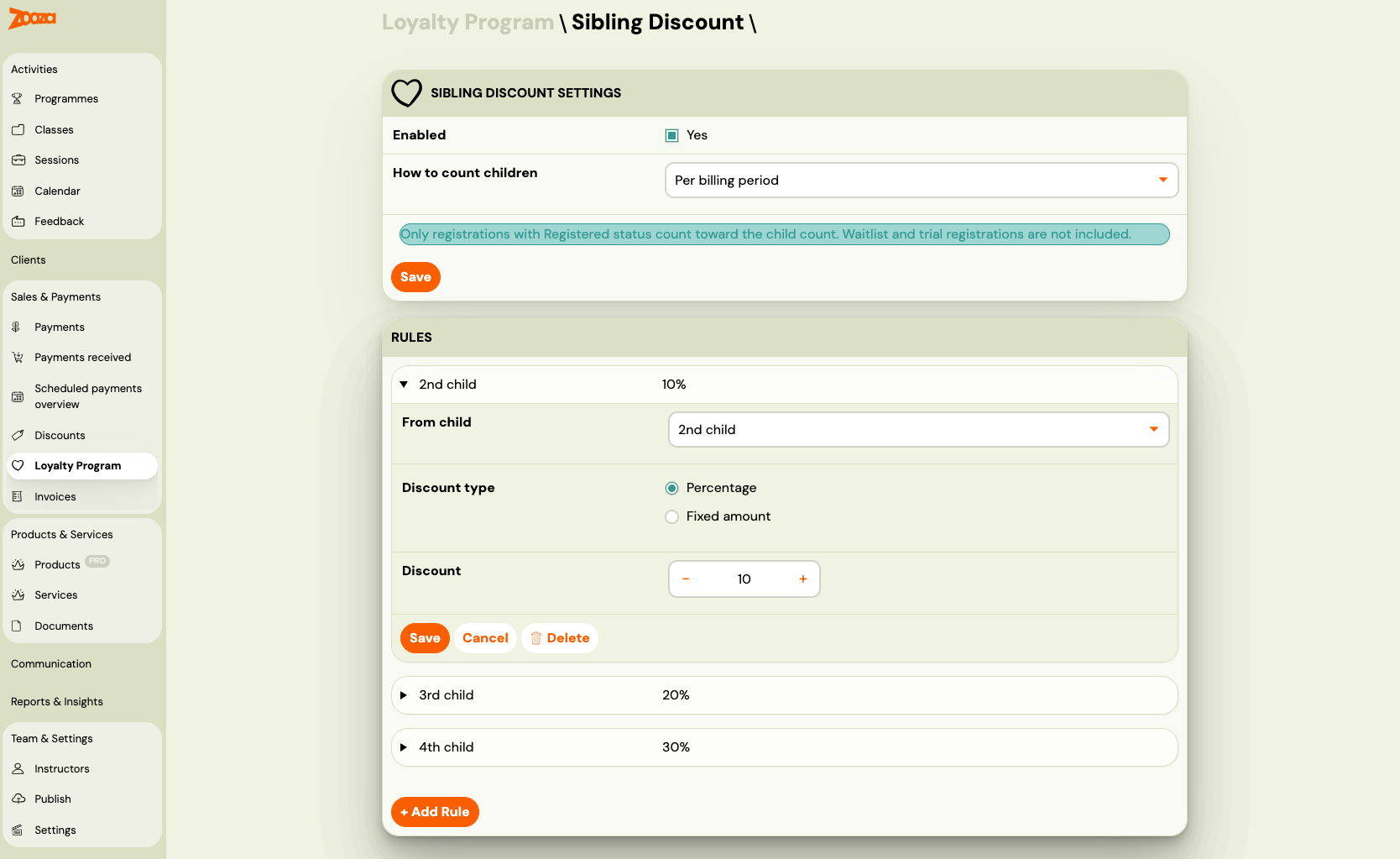
When a parent adds a second child to their account and enrols them, the sibling discount applies automatically at checkout. No code entry. No ”ask at reception.” The system recognises the family structure and adjusts pricing. This is the layer most activity businesses either skip entirely or handle manually — and manual means inconsistent. Read the full breakdown of how sibling discounts work in practice.
Layer 3: Returning Client Discount
Families in their second or third season get progressively better pricing — automatically. The system knows their enrolment history. A family returning for their fourth year of ballet classes doesn’t need to negotiate or ask. They see their loyalty reflected at the point of payment. This is the layer that directly attacks the retention moment — the one most businesses leave completely unprotected.
All three layers are configurable per business type and location. Full setup details are in the Zooza Loyalty Program documentation, with specific guides for referral configuration and sibling discount setup.
Why Most Activity Businesses Only Run One Layer
The business that has all three layers running simultaneously is rare. Here’s what we typically see:
-
A referral discount exists — manual, code-based, enforced inconsistently across locations
-
Sibling discounts are ”available if you ask” — no automation, reliant on staff memory
-
Returning client incentives don’t exist at all — long-term families pay the same as first-timers
Each missing layer is revenue left on the table. Not theoretical revenue — actual families who would have enrolled, would have added a second child, would have returned, if the friction at that moment had been removed.
Set It Once, Run It Every Season
The operational reality matters. Franchise owners and multi-location operators don’t need another system that requires training, monitoring, and manual intervention at every site.
Zooza’s loyalty system is configured once at the network level. After that, the three moments are covered automatically — for every booking, every family, every season, across every location. No codes to distribute. No staff training on discount rules. No spreadsheet tracking who referred whom. The system does the work. You review the results.
That’s the actual point of a loyalty program for a children’s activity business. Not generosity. Not marketing. Structural protection of the moments that determine whether your revenue grows or quietly erodes.
If you’re running a multi-location activity school and only one of these layers is active, you already know what to do next. See how Zooza handles all three.