Your Best Students Are Already Enrolled — Here’s How a Returning Customer Discount Keeps Them
Retention is a strategy, not an accident. Schools that keep families coming back year after year don’t do it by luck — they have systems. A returning customer discount for your activity school is one of the simplest, highest-ROI systems you can build. And yet most operators still spend 80% of their energy chasing new sign-ups while ignoring the families already in their chairs.
The Economics: Why Rewarding Returning Families Pays Off
Let’s start with the numbers that should change how you allocate your budget.
Acquiring a new student costs 5–7x more than keeping an existing one. That’s not opinion — it’s a well-documented finding from Bain & Company’s loyalty research. And according to Harvard Business Review, a 5% increase in customer retention produces a 25–95% increase in profit.
Now apply that to a dance studio, gymnastics club, or STEM school. A family who stays for year 2 and 3 is worth 3–5x a one-semester family. They refer friends, they enrol siblings, they rarely complain about price.
Here’s the concrete math: say you have 80 students. Around 10% — 8 families — are “at risk” of not re-enrolling next term. If you retain just 5 of them with a modest 10% discount on a €400 annual fee, you give away €200 in discounts but keep €1,800 in revenue. Replacing those 5 families through paid acquisition? Easily €500–€1,000 in marketing spend, plus the slower ramp-up of a new client.
The break-even almost always favours retention.
Tiered Loyalty vs. Flat Discount — Which Design Actually Works
A flat 10% discount for “returning customers” is simple. It’s also lazy. It doesn’t build loyalty — it devalues your price and gives away margin without creating any behavioural incentive to stay longer.
A tiered returning customer discount is different. It creates a progress effect:
- 1+ completed booking → 5% off
- 3+ completed bookings → 10% off
- 6+ completed bookings → 15% off
This works because of two psychological principles. The endowment effect — families value what they’ve already earned. And the goal-gradient effect, documented by Kivetz et al. (2006) — people accelerate effort (and commitment) as they approach the next reward tier.
A family in tier 2 has dramatically higher switching costs. Leaving your school means losing their earned status. That’s not a gimmick — it’s a deliberate retention architecture.
How to Manage Returning Customer Discounts Without Chaos
Manual discount management is where good intentions go to die. Here’s what happens in practice:
- Staff forget who qualifies and who doesn’t
- Discounts are applied inconsistently across locations
- Awkward checkout conversations: “Wait, do I get a discount?”
- Discount codes get shared, expire, or don’t match the payment type
- No data to evaluate whether the discount is actually working
The alternative: automatic discount application based on verified booking history. No codes. No manual checks. The system knows who qualifies and applies the right tier at checkout.
But automation only works if you make the right design decisions upfront:
- What counts as a qualifying booking? Only paid, completed registrations — not trials, not waitlist entries.
- Should there be a time gap? Yes. Without a cooling-off period, a parent who just finished a booking last week gets an immediate “returning” discount on their next one — that’s not retention, it’s a straight price cut. A time gap (e.g., 30 days) ensures you’re rewarding genuinely returning families, not concurrently enrolled ones.
- Discount type: Percentage works best for tiered systems. But consider how it applies across instalments, memberships, and pay-per-session models — it needs to be consistent.
If you’re also running sibling discounts alongside returning customer rewards, you’ll want both systems to work together without stacking errors. Zooza’s sibling discount feature handles this separately so you can layer loyalty strategies cleanly.
How Zooza Supports Returning Customer Rewards — Automatically
Zooza’s returning customer discount feature identifies returning clients by email address and applies the correct discount tier at checkout. No code needed, no manual verification.
Here’s how it works:
- Enable the feature in your loyalty settings
- Create a rule — define the name and scope
- Set tiers — choose booking thresholds and corresponding discount percentages
- Configure a time gap — set a cooling-off period so only genuinely returning clients qualify
- Publish — the discount applies automatically across all payment types: one-off, instalment plans, memberships, pay-per-session
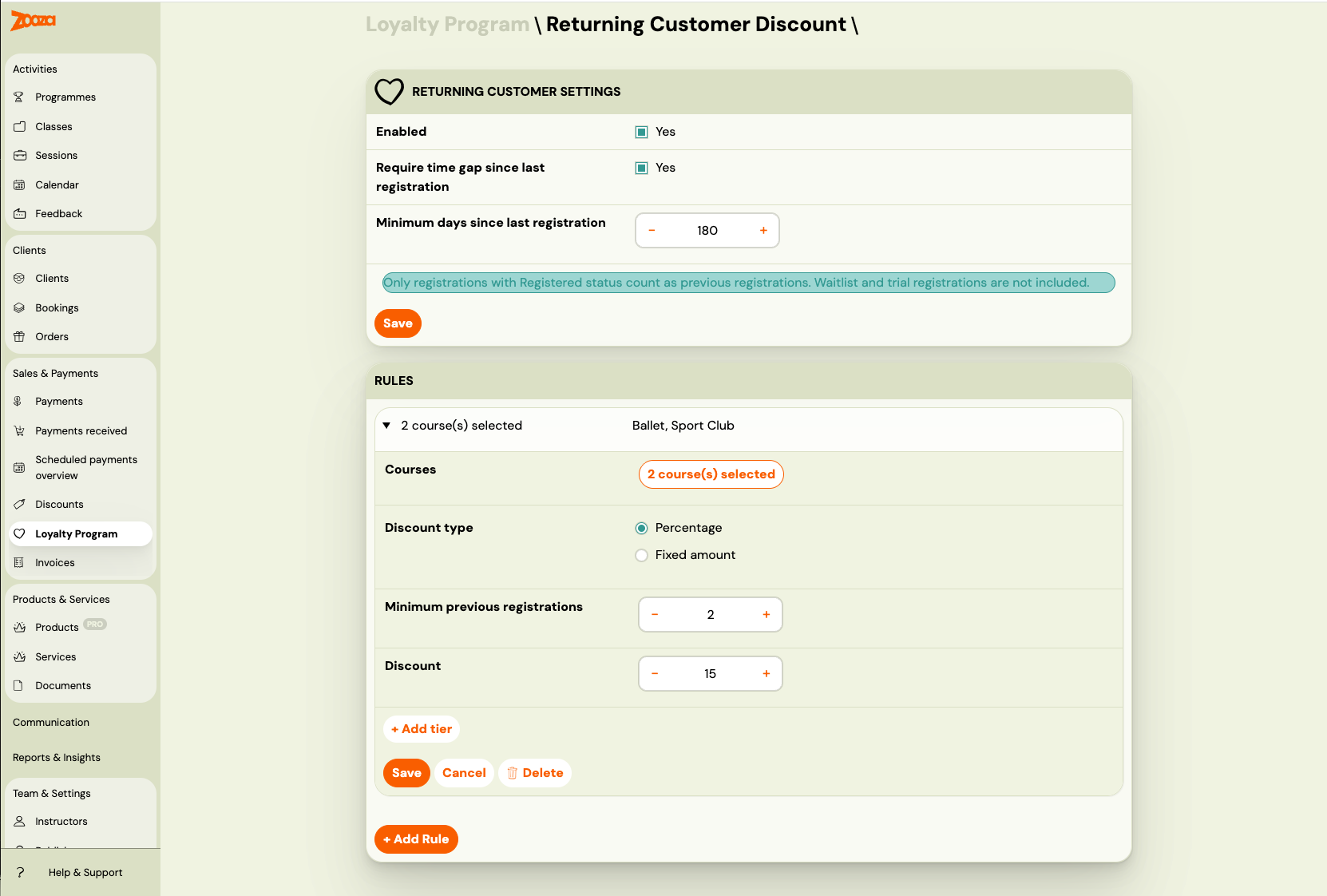
Real example: A dance school sets up 3 tiers — 1+ completed booking = 5% off, 3+ = 10%, 6+ = 15%. When a parent who has completed 4 bookings goes to check out for a new term, they see a 10% discount automatically applied. No code to enter. No awkward conversation. In the backend, the operator sees exactly which tier each family sits in and how much discount has been given across the network.
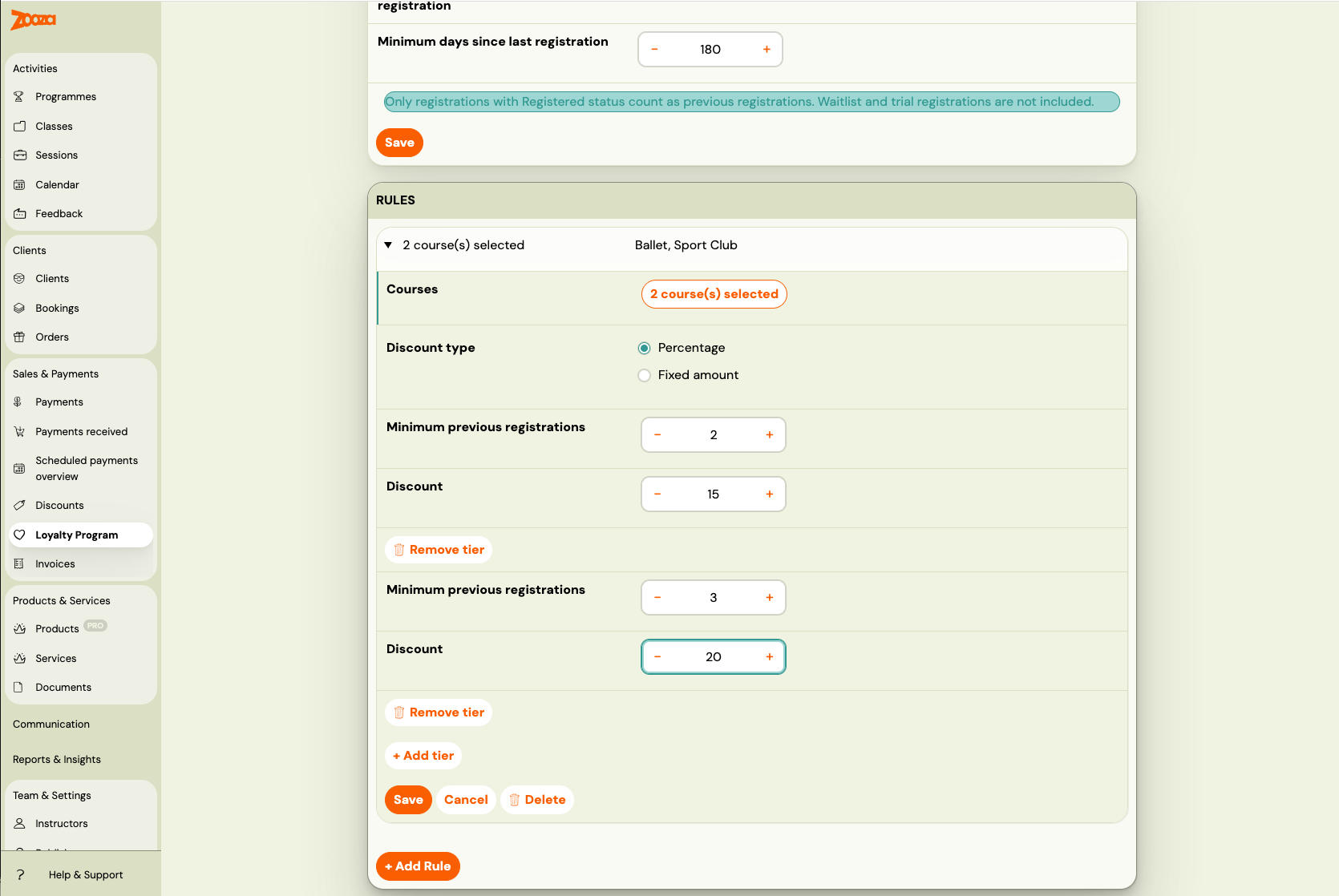
The time gap setting is particularly useful for multi-location operators and franchise networks. It prevents a family enrolled in a summer camp from immediately qualifying for a “returning customer” discount on a fall class booked the same week. You define the gap — 14 days, 30 days, 60 days — and the system enforces it.
For a broader view of how loyalty tools fit into Zooza’s platform, see the full loyalty program overview and feature set.
ROI Check: Is the Discount Actually Worth It?
Here’s a simple formula you can run right now:
(Retained clients × average booking value) − (total discount cost) = net loyalty ROI
Let’s use our 80-student school again:
- 8 at-risk families, average booking value €400/year
- You retain 5 of them with a 10% discount
- Revenue retained: 5 × €400 = €2,000
- Discount cost: 5 × €40 = €200
- Net retention ROI: €1,800
- Cost to replace those 5 families via ads and outreach: €500–€1,000+
That’s €1,800 in retained revenue for €200 in discounts, versus spending €500–€1,000 to acquire replacement families who may or may not stay. The economics aren’t close.
And this doesn’t account for the referrals, sibling enrolments, and word-of-mouth that loyal families generate — none of which shows up in the spreadsheet but all of which compounds over time.
Build the System, Not Just the Discount
A returning customer discount isn’t a giveaway. It’s a retention architecture. The schools that grow sustainably — the ones running 3, 5, 10 locations — have this built into their operating model. They don’t rely on charm or memory. They have a system that identifies loyal families and rewards them automatically.
If you’re still managing discounts manually or not offering them at all, you’re leaving revenue on the table and making it easy for families to leave. Set up your returning customer discount in Zooza — it takes minutes, and the ROI starts with the next checkout.