

Most children’s activity school owners launch a referral program, share the link once, and then… wait. Weeks pass. Maybe a referral trickles in, maybe not. Without clear referral program metrics for your children’s activity business, you can’t tell if your program is broken or just warming up.
This is the follow-up to our guide on setting up a referral program for your activity school. That piece covered the why and the what. This one answers the question that comes next: how do I read the results?
The Four Referral Program Metrics That Actually Matter
Forget vanity numbers. For a dance studio, music school, or kids’ STEM club, these four metrics tell you everything you need to know:
- Referral Rate — What percentage of your active clients have referred at least one person? A healthy benchmark for children’s activity businesses is 15–25%. Below 10%? Your clients either don’t know the program exists or don’t care enough about the reward.
- Conversion Rate of Referred Leads — Referred leads convert 3–5x better than cold traffic, according to Nielsen’s research on trust in advertising. If your referred leads aren’t converting significantly better than walk-ins or ad clicks, the offer for the new person is probably too weak.
- Time-to-First-Referral — Most referrals happen in months 2–4 of a client relationship, not month 1. Parents need time to experience your classes, see their child progress, and build conviction before they’ll recommend you. If you’re measuring at 30 days, you’re measuring too early.
- LTV Ratio: Referred vs. Non-Referred Clients — Research from Wharton shows referred customers have 16–25% higher lifetime value. They stay longer, pay more consistently, and churn less. If you’re not seeing this gap, your referral incentive might be attracting deal-seekers rather than committed parents.
What the Numbers Look Like in Practice: Nova Dance Studio
Let’s make this concrete. Nova Dance Studio has 120 active clients. They launched a referral program offering a €15 credit to the referrer for every new enrollment, plus a €10 discount for the referred family’s first month.
Here’s what their dashboard showed over 90 days:
Nova Dance Studio — Referral Metrics Over 90 Days
- Referral Rate: 30 days: 2.5% → 60 days: 8% → 90 days: 17%. What it means: Slow start is normal. The jump between 60–90 days came after the first wave of referrers received their credit and mentioned it to other parents.
- Referred Lead Conversions: 30 days: 2 of 3 (67%) → 60 days: 6 of 10 (60%) → 90 days: 14 of 22 (64%). What it means: Consistent 60%+ conversion — far above their 18% conversion rate from Instagram ads.
- Time-to-First-Referral: Average: 11 weeks after a client’s first enrollment. What it means: Right in the expected window. Don’t panic at week 4.
- Referred Client Retention at 90 Days: 93% vs. 74% for non-referred clients. What it means: Already showing the LTV gap that compounds over time.
The takeaway: Nova’s program wasn’t broken at day 30 — it was loading. By day 90, referrals accounted for 1 in 5 new enrollments.
Three Diagnoses When Your Referral Program Isn’t Working
If you’re past the 90-day mark and the numbers still look flat, it’s diagnosis time. In our experience across hundreds of activity schools, the problem is almost always one of these three:
1. Clients Don’t Know the Program Exists
You announced it once in a newsletter. That’s not enough. Parents are busy. They forgot. The fix: automated reminders. The best-performing schools trigger a referral reminder after the 3rd payment — the point where a client is clearly committed. Research from HBR on NPS and referral behavior confirms that the correlation between satisfaction and willingness to refer peaks after the client has had enough experience to form a strong opinion.
2. The Reward Feels Too Far Away
If your threshold is “refer 3 friends to earn a free month,” most parents will never get there. They refer one person, see no reward, and stop trying. The fix: lower the first milestone. Give a small reward for the first referral. One successful referral = one tangible benefit. You can always add bigger rewards for higher tiers later.
3. Referred Friends Never Convert
This one’s subtle. Your existing clients are referring — but the new families aren’t signing up. The problem: your reward is one-sided. The referrer gets something; the new family gets nothing. The fix: two-sided rewards. Both the referrer and the new family need to benefit. A €10 discount for the new family’s first month removes friction at exactly the right moment.
What “Working” Looks Like at Six Months
Here are the benchmarks to aim for. If you hit these, your referral program metrics for your children’s activity business are in excellent shape:
- Referral rate ≥ 18% — nearly 1 in 5 active clients has referred someone
- Referred client LTV ≥ non-referred LTV — confirming the Bain research on loyalty economics: NPS leaders grow referral revenue 2.5x faster than laggards
- At least 1 in 5 new enrollments traceable to referral — a meaningful, measurable channel
- Average time-to-first-referral declining — a sign that your program is becoming part of the client experience, not an afterthought
If you operate multiple locations or a franchise, these benchmarks become even more valuable. Comparing referral performance across locations tells you which site managers are actively promoting the program and which are letting it collect dust.
How Zooza Makes All of This Visible — Automatically
Tracking these metrics manually — in spreadsheets, with notes on paper — is possible for a single 30-client class. It’s not possible for a multi-location business with hundreds of families. This is where Zooza’s built-in loyalty tools earn their keep.
Activity Log: Every referral event is timestamped — who referred whom, when the referred client enrolled, when the reward was triggered. No guesswork. You can review this in the Activity Log at any time.
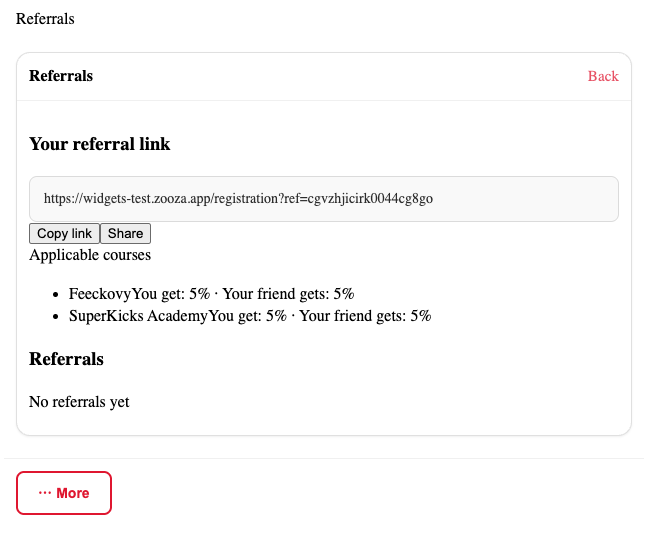
Client View: Each client sees their own personal referral link and can track their progress toward rewards. This is critical — visibility drives engagement. When a parent can see “1 of 2 referrals completed,” they’re far more likely to send that second link. See the full Client View setup.
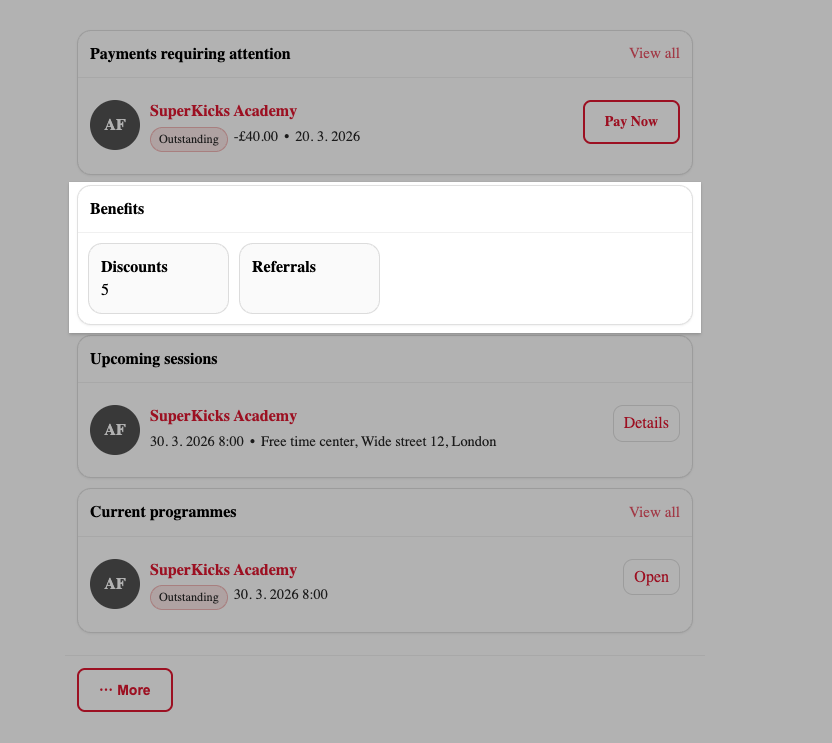
Once clients click through to their referral dashboard, they see exactly how many referrals they’ve made and what rewards they’ve earned — creating a self-reinforcing loop.
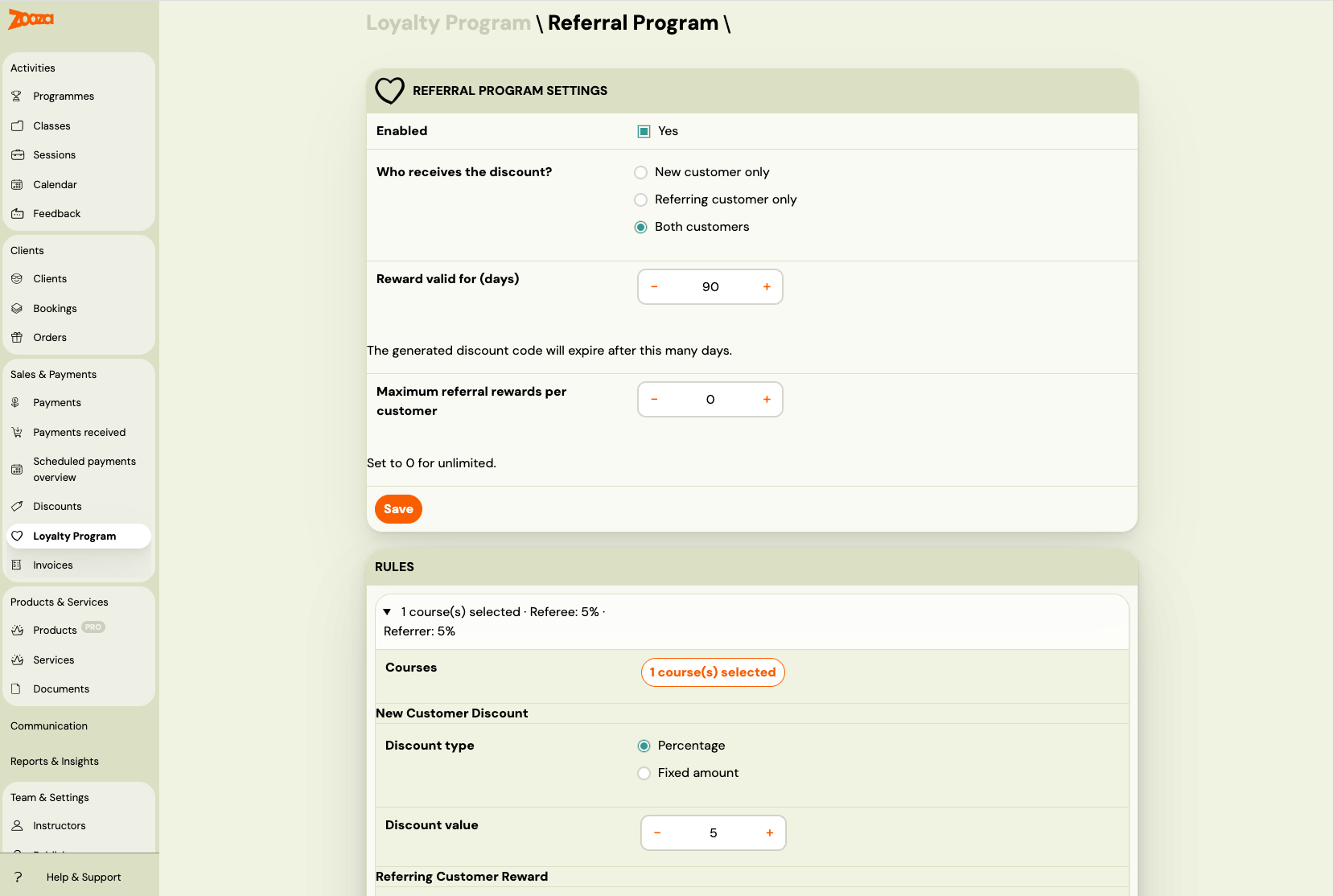
Dashboard Metrics: Referral rate, conversion rate, reward redemptions — all visible in one place. For franchise operators, this is filterable by location. The Loyalty & Referral documentation walks through every setting, and the Loyalty Program overview covers the full picture.
One Takeaway You Can Act On Today
If you launched a referral program more than 90 days ago and you can’t answer “what’s my referral rate?” from memory — that’s the problem. Not the program. Not the reward. The problem is flying blind.
Start by pulling three numbers: how many clients have referred, how many of those referrals converted, and how those clients’ retention compares to non-referred families. If you don’t have those numbers yet, revisit the setup guide — and this time, make sure the tracking is baked in from day one.