

9 min read · Practical guide for owners of dance schools, swim schools, sports clubs, and children’s activity providers
Here’s a number that should change how you think about your marketing budget: acquiring a new customer costs 5 to 25 times more than keeping an existing one. That’s not a motivational poster quote — it comes from a Harvard Business Review analysis of customer acquisition costs across industries, and it holds for small businesses just as much as large ones.
Yet if you look at how most children’s activity schools spend their marketing budget, you’ll find the opposite logic at work. Money goes to Facebook ads, Instagram reels, Google campaigns, flyer drops. All of it aimed at attracting strangers. Meanwhile, the families who are already through the door — the ones who already trust you, already love what you do — get almost no intentional attention at all.
This article is about fixing that. Not by abandoning outbound marketing, but by understanding where the real leverage is, and making sure you’re not leaving the highest-ROI activities on the table.
Why Marketing Children’s Activities Is Different
Before diving into tactics, it’s worth understanding why the standard marketing playbook doesn’t transfer cleanly to children’s activity businesses.
Your market is local and finite. A swim school in a mid-sized city might have 5,000 families within a realistic catchment area. You’re not selling to the internet. Every new customer you acquire through paid ads is one of a limited pool — and once they’re in, keeping them is far more valuable than finding a replacement.
Capacity is fixed. You can’t just scale up by running more ads. If your Tuesday 5pm class has 12 spots and 12 children in it, a brilliant Instagram campaign doesn’t help you — it creates a waitlist. Your growth is constrained by physical space and instructor hours. This means the value of each filled spot is high, and the cost of losing one is higher than most owners calculate.
Trust is the primary buying signal. Parents are not choosing a children’s activity the way they choose a supermarket. They’re deciding who to hand their child to for 90 minutes every week. That decision is not made based on a Facebook ad. It’s made based on what another parent told them at school pickup. The channel that converts best is not the one you pay for — it’s the one you earn.
Decisions are seasonal, but relationships are not. Registrations cluster around September and January. But the family that registers in September and stays for three years is worth ten times the family that tries one term and leaves. Seasonal marketing fills spots. Relationship marketing builds a business.
The Marketing Funnel for Children’s Activities
Most businesses think of a marketing funnel as something that starts with advertising and ends with a sale. For children’s activity providers, the funnel is different — and the most important stages are the ones that happen after the sale.
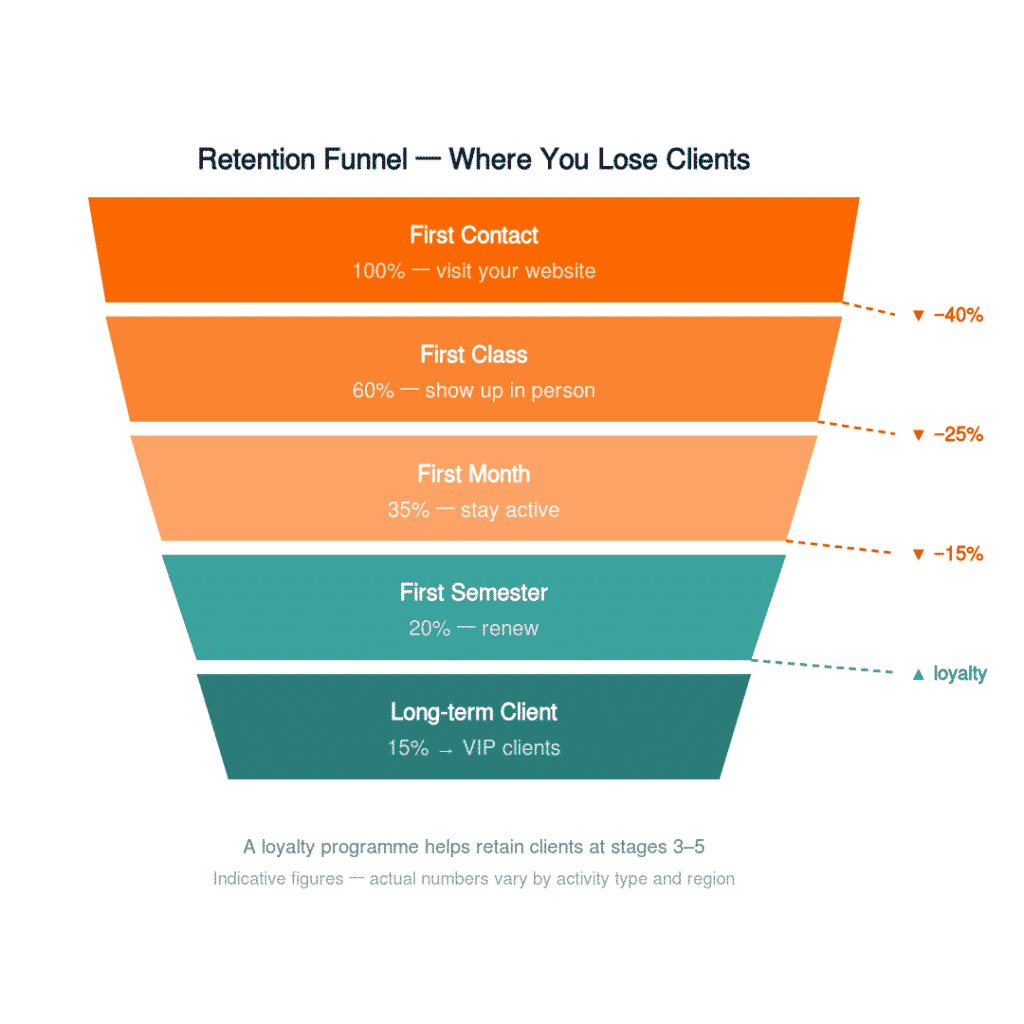
The stages, and where most schools lose people:
- Awareness — Parents hear about you. This is where most marketing spend goes. But in children’s activities, the majority of awareness comes from word of mouth, not paid channels.
- Trial — A parent books a trial session. This is your most powerful conversion moment. Most schools treat it as an admin task. It should be treated as your single most important marketing event.
- Registration — The family signs up. The average trial-to-registration conversion for well-run children’s activity schools is 60–70%. If yours is significantly lower, the problem is the trial experience, not your acquisition.
- Retention — The family comes back next term, and the term after that. This is where the economics of your business are determined. A family that stays for 3 years is worth 6× a family that stays for 6 months.
- Referral — A retained, satisfied family recommends you to others. This is the top of the funnel for your next new customer — and it costs you almost nothing.
The insight here is simple: the bottom of the funnel feeds the top. A strong referral base means you need to spend less on awareness. Strong retention means your referral base grows automatically. This is why schools that focus on retention and referral compound their growth, while schools that rely on paid acquisition run in place.
Why Paid Ads, Social Media, and SEO Are Not Enough
This is not an argument against paid channels. They have a role, especially for new schools or schools entering a new area. But they have structural limitations for children’s activity providers that most owners underestimate.
Parents don’t search for children’s activities the way they search for a plumber. When a pipe bursts, you Google “emergency plumber near me.” When you’re looking for a swim school for your 6-year-old, you ask other parents. A 2021 Nielsen study found that 88% of consumers trust recommendations from people they know above all other forms of advertising. That number is higher for decisions that involve their children.
Nielsen Global Trust in Advertising, 2021
The conversion funnel for paid ads is long and leaky. A parent sees your Facebook ad → clicks → reads your website → maybe books a trial → maybe shows up → maybe registers. Each step has drop-off. The cost per registered student through paid channels is often €80–150 for a local children’s activity business. Word-of-mouth referrals convert at a fraction of the cost because the trust has already been established before the first conversation.
Social media builds brand, not bookings. Posting consistently on Instagram is valuable for credibility — when a referred parent looks you up, your social presence should reassure them. But social media rarely drives direct bookings for local activity providers. It’s a supporting channel, not a primary one.
None of this means stop the ads. It means: if your retention rate is 50% and your trial conversion is 40%, fixing those numbers will generate more revenue than doubling your ad spend.
The Trial Session: Your Most Powerful Marketing Moment
A parent who books a trial is already 80% of the way to becoming a customer. They’ve heard about you from someone, they’ve taken the time to book, they’ve shown up. The question is whether your trial converts them — or loses them.
Most activity schools treat the trial as a sampler. The child tries the class, it goes fine, and then… nothing. The parent goes home, life gets busy, and the registration that felt inevitable never happens.
What a well-run trial looks like:
- Before: A confirmation message that tells the parent what to expect, what to bring, and what the child will do. This reduces anxiety and shows professionalism before the parent has even met you.
- During: The instructor knows the child’s name before they arrive. Someone welcomes the parent, not just the child. At some point — briefly — the instructor connects with the parent directly. Not a sales pitch. Just a human moment: “She picked it up really quickly.”
- After: A follow-up within 24 hours. Not automated spam — a short, personal message. “It was great to have [name] today. We have spots open for next term. Happy to answer any questions.” This step alone can lift your trial-to-registration conversion by 15–20 percentage points.
The trial session is the moment where a stranger becomes a customer — or doesn’t. It deserves more intentional design than almost any other part of your business.
Retention Is Marketing, Not Operations
Most activity school owners think about retention as an operational matter: keep quality high, don’t cancel classes, respond to messages promptly. All of that matters. But retention is also a marketing discipline — and it’s where the most underutilised leverage sits.
Let’s look at the numbers. Consider a swim school with 80 students paying €80/month.
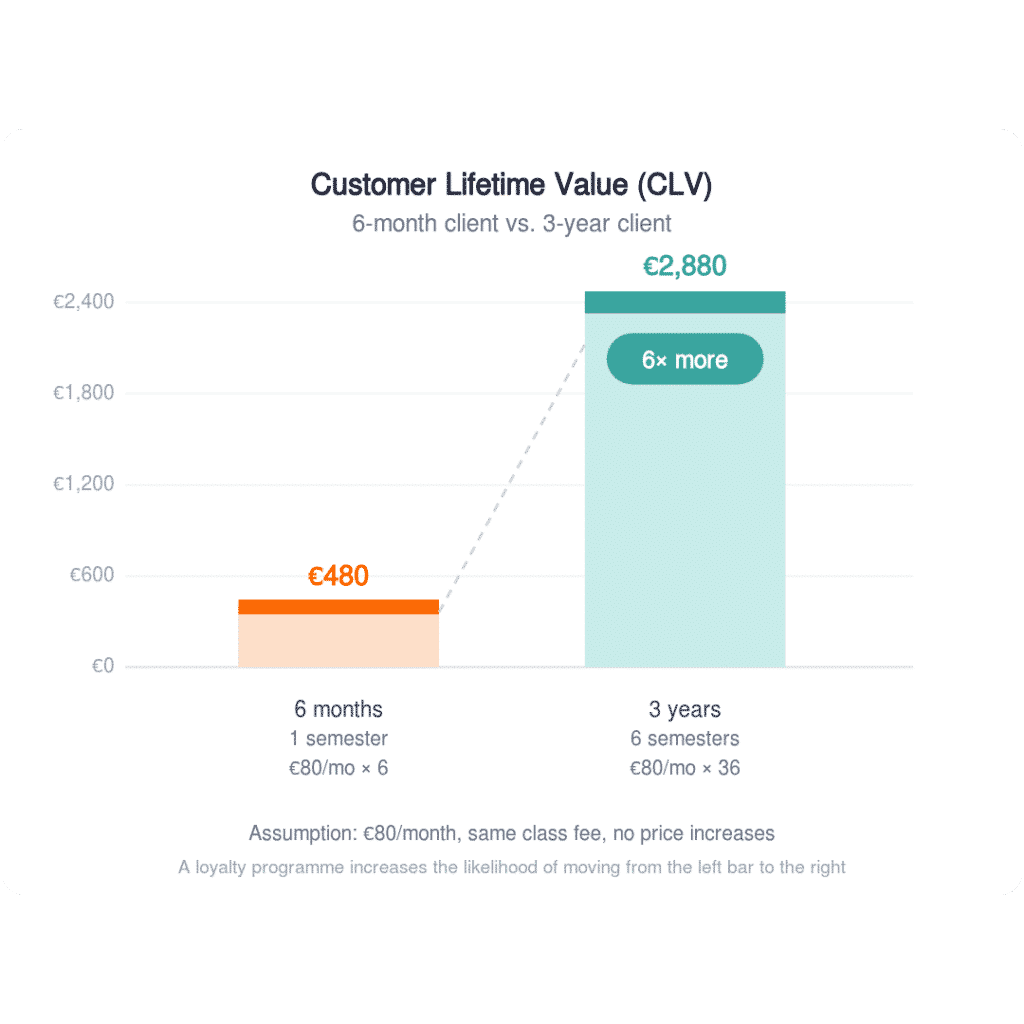
- A student who stays for 6 months: €480 lifetime value
- A student who stays for 3 years: €2,880 lifetime value
If you move your average retention from 8 months to 18 months, you’ve effectively more than doubled your revenue per student — without acquiring a single new customer. Bain & Company research showed that a 5% increase in customer retention can increase profits by 25% to 95%, depending on the business model.
Harvard Business Review — The Value of Keeping the Right Customers (2014)
Where retention is actually lost:
- The gap between registration and the first session. Families who register but feel no connection before their first class are more likely to quit quietly. A simple welcome message and a “here’s what to expect” guide closes this gap.
- The end-of-term drop-off. Many children’s activity schools see 20–30% of students not return after summer. This is often not because they were unhappy — it’s because re-registration required effort and nobody nudged them. An early re-registration offer or a simple “we’re saving your spot” message can cut this in half.
- No relationship with the parent beyond transactional communication. Invoices, schedule changes, cancellations. If the only contact parents have with your school is administrative, they have no emotional reason to stay when life gets complicated.
Referral Marketing: System vs. Chance
Every school that has been running for more than a year is getting referrals. Parents talk. Children come home and tell their friends. Families recommend you at the school gate. This is already happening — the question is whether it’s happening by accident or by design.
Passive word-of-mouth is real but unreliable. It depends on whether a satisfied parent happens to be talking to someone whose child doesn’t yet have an activity, whether the topic comes up naturally, whether they remember to mention your name. Most of the time, the recommendation never happens — not because the parent wasn’t happy, but because there was no trigger and no structure.
What active referral marketing adds:
- A clear, easy mechanism for parents to share your school (a link, a card, a code)
- A small but meaningful reward for both the referrer and the new family
- A moment in the relationship when you explicitly ask — which most schools never do
A study published in the Journal of Marketing found that referred customers have a 16–25% higher lifetime value than customers acquired through other channels — they stay longer, spend more, and refer others at higher rates.
What stops parents from referring: It’s almost never lack of enthusiasm for your school. It’s friction. They don’t know there’s a referral program. They have to remember a code. The reward feels too small to bother. The solution is to make it effortless: a personal referral link they can copy and send in one tap, a discount that feels genuinely valuable, and a reminder at a natural moment (end of a great class, start of a new term).
Common Mistakes and What to Watch Out For
Spending on ads before fixing retention
If you’re losing 40% of students each term, spending more on Facebook ads is like filling a bucket with a hole in it. Audit your retention rate first. If it’s below 70% term-on-term, that’s where your marketing investment belongs — not in acquisition.
No follow-up after the trial session
The 24-hour window after a trial is the highest-converting moment in your entire funnel. Most schools let it pass without any contact. A single short, personal message at this moment will outperform a month of social media posts.
Referral “marketing” that isn’t a system
“If you know anyone who might be interested, feel free to send them our way” is not a referral program. It produces occasional referrals. A system — with a link, a reward, a clear ask at the right moment — produces consistent referrals. The difference compounds over time.
Ignoring parent feedback until someone leaves
Most schools find out a family is unhappy when they don’t re-register. By then, it’s too late. A simple end-of-term pulse question (“How likely are you to recommend us to a friend? Anything we should improve?”) surfaces problems while there’s still time to address them. It also signals to parents that you care — which itself improves retention.
Treating all students as equally at risk
A family in their third year is not at the same churn risk as a family in their third week. Early-term students, especially those who missed a session or haven’t responded to communications, need more attention. Knowing which students haven’t re-registered yet — and reaching out before the deadline passes — is basic retention management that many schools do manually and inconsistently, or not at all.
A Practical Plan: Three Things to Do This Week
You don’t need to overhaul your entire business. Three focused actions will move the needle more than any marketing campaign:
- Set up a 24-hour trial follow-up. After every trial session, send a short personal message within one day. Thank the parent for coming, mention one specific thing the child did well, and include a clear next step (how to register, how to ask questions). If you have multiple trials per week, template this — but keep it human.
- Calculate your term-on-term retention rate. How many students from last term came back this term? If you don’t know this number, find out. It’s the single most important metric in your business. Once you know it, you have a baseline — and you can measure whether anything you do is actually working.
- Ask five retained families for a referral. Not a mass email. Five personal messages to families you know are happy. Tell them you’re growing and that you’d love their help. Give them something easy to share — a link, a code, a simple “forward this to anyone who might be interested.” Do it this week. See what happens.
The Bottom Line
The best-run children’s activity businesses are not the ones with the most followers on Instagram or the highest ad spend. They’re the ones where parents feel genuinely cared for, where children are known by name, and where families come back year after year and bring their friends.
That’s not accidental. It’s built through intentional attention to retention and referral — the two marketing activities with the highest return on investment, the lowest cost, and the greatest long-term impact on your business.
The tools to do this well don’t need to be complicated. They need to be consistent.
“It takes months to find a customer, seconds to lose one.” — Vince Lombardi
If you run your children’s activity business on Zooza, the retention and referral tools described in this article — automated re-registration reminders, trial follow-up workflows, and a structured referral program with personal links and automatic rewards — are built into the platform. You don’t need separate software or manual processes. You need to turn them on and configure them once.
Start with the three actions above. The compounding effect takes care of the rest.