Cold Interest Isn't a Booking Yet: Lead Generation and Follow-up for Children's Activity Businesses
Picture the parent your ad just reached. It’s 9:40 in the evening, they’re scrolling on the sofa, and your video of a class full of laughing five-year-olds stops their thumb. They tap. And what they land on is a booking form: pick a class, pick a day, enter card details.
They weren’t ready for that. They wanted to ask whether their shy four-year-old would cope, whether there’s a group near the new house, whether you’d take a child who’s never done ballet. They close the tab. You paid for the click. Nothing happened.
That’s the paradox at the heart of most paid campaigns — most lead generation, really — in our sector: the ad reaches people who are interested, and the landing page demands people who are decided. The gap between those two is where the budget goes.
This article is about closing that gap. It’s about cold interest — what the research says about it, when it’s the right thing to collect, the follow-up process that turns it into enrolments, and the new set of tools in Zooza built for exactly this: a contact form for your website, a Contacts section in the app, and an integration with Meta Lead Ads that pulls leads from Facebook and Instagram straight into your follow-up workflow.
Why term start is when this matters most
Term start is when the sector spends. New term, new classes, new locations, a wave of parents who just watched their child start school and are wondering what else they should be doing. It’s also when competition for those parents is loudest, and the businesses that grow aren’t the ones with the biggest budget — they’re the ones with a process for what happens after the click.
It’s also the question we hear most from providers running ads: “what do I do with the parents who aren’t ready yet?” Booking software, ours included, has traditionally started at the booking. This article — and the tools it ends with — start one step earlier.
Why cold leads are the normal state: the 95:5 rule, speed to lead and form friction
Three findings from outside our sector explain most of what goes wrong with paid campaigns in it.
Almost everyone you reach isn’t ready to buy right now. The 95:5 rule, from Professor John Dawes at the Ehrenberg-Bass Institute and the LinkedIn B2B Institute, holds that at any moment only around 5% of a category’s potential buyers are in-market; the other 95% will buy at some point, but not today. The research is B2B, but the mechanism is universal — and in children’s activities it’s arguably sharper, because the “buying moment” is pinned to term dates, a child’s age, a house move, a friend’s recommendation. A parent who sees your ad in March and enrols in September is not a lost lead. They’re the normal case. Advertising, Dawes argues, mostly works by building memory that activates when the buyer does come into the market. So the question isn’t “how do I make them decide now?” — it’s “how do I make sure I’m the one they remember, and that I have a way to reach them, when the moment arrives?”
Two terms are worth pinning down, because the rest of this article hangs on them. A cold lead is a person who has shown interest — tapped an ad, left a name and an email — but doesn’t yet know you and hasn’t committed to anything. Speed to lead is the time between that enquiry arriving and your first human reply. Most of what separates campaigns that fill classes from campaigns that burn budget is what happens in that gap.
When they do raise a hand, speed decides everything. The most-cited study on lead response is still the Harvard Business Review audit by Oldroyd, McElheran and Elkington. They sent a test enquiry to 2,241 US companies and timed the response. Firms that contacted the lead within an hour were nearly seven times as likely to have a meaningful conversation with the decision-maker as firms that waited even an hour longer — and more than sixty times as likely as those that waited 24 hours. The average response time among companies that replied at all was 42 hours. Interest is perishable: the parent who enquired at 9:40pm is comparing three providers, and the first one to answer warmly is the one that feels like the obvious choice.
Friction on a phone is fatal. Google’s own research found that 53% of mobile visits are abandoned when a page takes longer than three seconds to load — and that’s before a single form field is filled in. The parent on the sofa is on a phone, with one thumb, half-watching a series. Every second of loading and every field they have to type is a reason to stop. This is precisely the problem Meta built instant forms to solve: the form opens inside Facebook or Instagram, the contact details are pre-filled from the profile, and there’s nothing to load. Meta’s data says advertisers who ran instant forms alongside website forms saw, on average, 60% lower cost per lead and 125% more leads than website forms alone. Take the exact numbers with the usual caution — they’re Meta’s — but the direction matches what every provider who’s tried both tells us.
Put those three together and the shape of the problem is clear. Most of the parents your ad reaches aren’t ready; the ones who are ready need a reply within the hour; and the form you ask them to fill in has to be nearly effortless. A booking form fails all three tests for a cold audience. A lead form, followed by a fast human, passes them.
Booking form or lead form? A simple rule
None of this means bookings are wrong. For a warm parent — one who already knows you, or who’s been sent by a friend, or who’s looking at a class with a clear time and price — a direct trial booking is the best thing you can offer. Fewer steps, immediate commitment — and operators using Zooza’s trial flow regularly see over half of those trials convert into enrolments.
The rule of thumb is this:
- If the parent can decide in one sitting, send them to a booking. Known class, known time, known price, no placement needed.
- If you’d normally talk to the parent before enrolling them, send them to a lead form. Anything that needs a conversation, an assessment, a “we’ll let you know when”, or a relationship first.
Cold traffic from a paid campaign almost always falls into the second group. So does anything you haven’t launched yet.
Five situations where a lead beats a booking
These are the cases we built the new contact form and the Meta integration for. Notice what they have in common: in each one, the person is new to you, and a payment isn’t the next step — a conversation is.
1. A programme that needs placement. Music grades, swimming stages, football by ability, language courses by level. You can’t let a parent self-book into “Stage 3” when they don’t know what Stage 3 means. What you need from the ad is a name, a child’s age, and a line about their experience — then your team places them in the right group and books the trial. Asking for a booking here produces mis-placed children and refund requests. Asking for a lead produces a well-placed child and a parent who felt looked after from the first contact.
2. Testing a new location before you commit to it. You’re weighing a second venue on the other side of town. The cheapest way to find out whether there’s demand is to run a small campaign to that postcode with “Register your interest — opening in January” and count the hands. Fifty enquiries in a month and you sign the lease; five and you’ve saved yourself a year of half-empty classes. Our benchmark data puts average occupancy across the sector at around 54% — the last thing you want is to add a venue that drags that lower. You cannot take a booking for a class that doesn’t exist yet. You can absolutely take a lead.
3. Franchise enquiries. If you’re a franchisor, the people you’re advertising to aren’t parents at all — they’re prospective owners, and the “purchase” is months away. FranConnect’s 2025 Franchise Sales Index, drawn from 3.4 million leads across 460+ brands, shows the overall lead-to-agreement rate sitting around 1.5%, and calls speed-to-lead “the cheapest conversion lever in franchise development”. That’s a lead-management problem by definition: capture, qualify, nurture, and never let an enquiry go unanswered. We’ve written a full guide to franchising your children’s activity business; the front door to all of it is a form that captures the interest and a process that answers it fast.
4. Finding new instructors. Growth in this sector is usually capped by the number of good teachers you can find, not the number of children. A recruitment ad on Instagram — “Love working with kids? We’re hiring swim teachers in Leeds” — is a lead campaign like any other, and the same rules apply. Robert Half’s survey of professionals found 62% lose interest in a role if they don’t hear back within two weeks. The candidate who fills in your form on Tuesday and hears nothing until the following Monday has already accepted somewhere else.
5. Building an audience for something new. A new school you’re opening, a new offer you’re about to launch, a newsletter for parents in an area you’re entering. The interest you’re collecting here is genuinely cold — these are people who may never have heard of you — and the ask has to match: “Want to hear when we open?” not “Enrol now”. This is the one case that also works on your existing families: when you launch a new product or a new location, a lead form lets the parents you already have tell you they’re interested before you’ve built the timetable, so you launch into demand rather than hoping for it.
What all five share is that the payment happens later, after a follow-up you control — a call, an email, a placement, an invitation. Which brings us to the part that decides whether any of this works.
Speed to lead: the follow-up process that converts enquiries
Collecting leads is easy. Most providers who’ve tried it have the same complaint: “we got fifty enquiries and three signed up”. Almost always, the problem wasn’t the leads. It was the seven days between the enquiry and the first reply. Here’s the process we see working, use case by use case.
Minute 0 — the automatic reply. The moment the form is submitted, the parent gets a short, warm, personal-sounding email in their language: “Thanks, Sarah — we’ve got your enquiry about swimming for Ella. Someone from the team will be in touch today. In the meantime, here’s what a first lesson looks like.” It doesn’t replace the human; it buys you the hour and tells the parent they’ve been heard.
Within the hour — a human first touch. This is the HBR finding turned into a rule. Every new enquiry gets an owner the moment it arrives, and the owner’s job is one thing: a first, personal contact, today. For most use cases, a call beats an email — it’s faster, it answers the real question (“will she cope?”), and it’s what a parent choosing between three providers remembers.
The first touch is a question, not a pitch. The scripts that work are short:
- Placement programme: “Tell me a little about what Ella’s done before — and we’ll find her the right group. Would Tuesday or Saturday suit for a trial?”
- New location: “Thanks for registering interest in the Northfield venue. Which days would work for you? That’s genuinely shaping our timetable.”
- Franchise: “Thanks for your enquiry — I’d love to hear what’s drawing you to this. Do you have twenty minutes this week for a call?”
- Instructor: “Great to hear from you. Could you tell me a bit about your experience with children? We’re interviewing this week.”
- New audience / newsletter: no call — a short sequence of two or three emails over the following weeks that introduces you, shows a class, and ends with a concrete first step.
Qualify, then move the lead along. Not every enquiry becomes a client, and that’s fine — the point of a status is to know where everyone stands. New means no one has spoken to them yet. In progress means the conversation is live. Lost means it’s over, with a reason. Converted means they’ve become a client. A list where every lead has a status and an owner is a list where nobody falls through the crack.
Convert into the real thing. The moment a parent says yes, the lead should become a client and a booking in one movement — a trial, a class, a place on the new venue’s list — without re-typing anything and without losing the history of where they came from and what they asked.
Measure the whole chain, not just the lead. Cost per lead is a vanity metric on its own. Fifty leads at £4 each that produce two enrolments are worse than twenty at £10 that produce eight. Track the campaign the lead came from (UTM parameters, click IDs), the status it ended at, and — once converted — what the family is worth over a year. That’s cost per enrolment by channel, which is the only number that tells you where to put next month’s budget. We covered the measurement side in depth in website event tracking for bookings; the same events now exist for the contact form.
Do this consistently and the maths changes. The sector’s retention benchmarks mean most providers are replacing the majority of their families every year — so every enquiry you answer within the hour, place well, and convert is compounding value, not a one-off sale.
Where Zooza comes in: lead capture, Contacts and Meta Lead Ads in one workflow
Everything above is possible with a spreadsheet, a shared inbox and discipline. Almost nobody sustains it that way through a September. So we’ve built the process into the product.
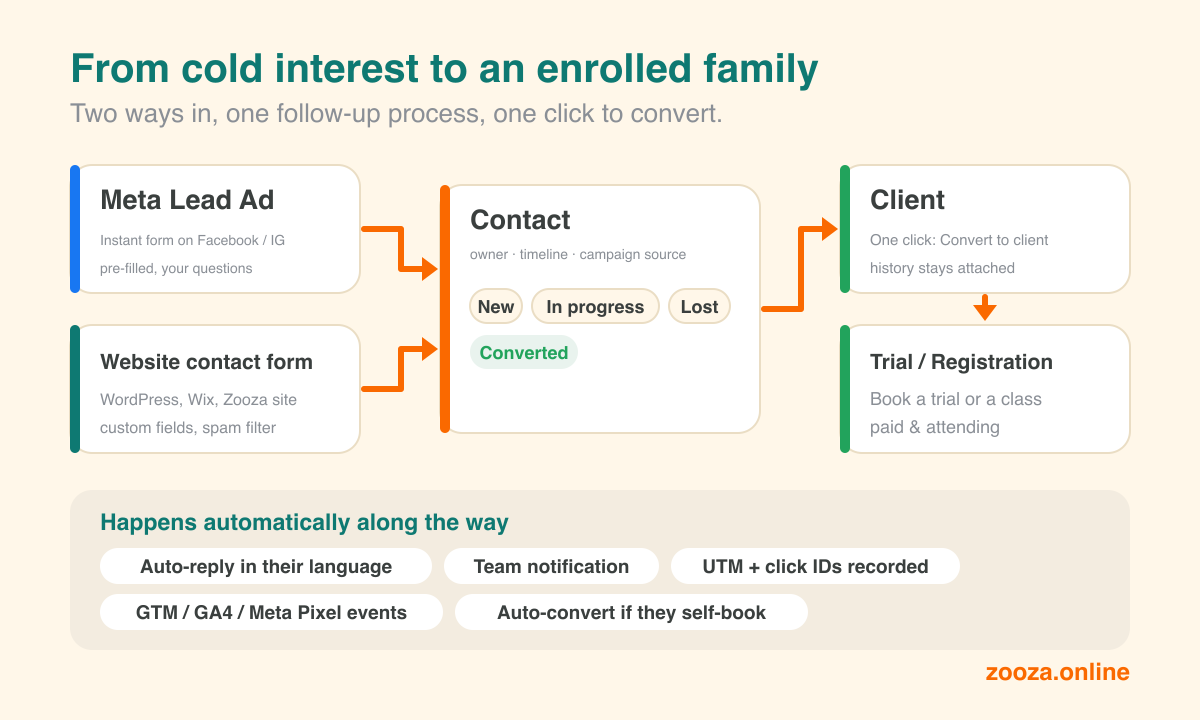
A contact form widget for your website. Drop it on any page — WordPress, Wix, Squarespace, your Zooza site — and every submission becomes a contact in your account rather than an email that gets lost in the inbox. Name, email, phone and message are built in and toggleable; you add your own questions with custom fields (child’s age, location of interest, “how did you hear about us”). Hidden fields let one form serve several locations, tagging each enquiry with the venue automatically. Spam is filtered into its own list without anyone reviewing it. The form is fast, mobile-first, and rendered in the parent’s language.
A Contacts section in the app. Under Clients there’s now Contacts: every enquiry with a status (New, In progress, Lost, Converted), an owner, the full timeline of what they asked and when, and filters for status, owner, form, source, label and — critically — UTM source, medium and campaign. If the parent is already a client, Zooza links the enquiry to their record instead of creating a duplicate. Your team gets a notification for every new enquiry, and the parent gets your automatic reply in their language, from your message templates.
Meta Lead Ads, connected. This is the one we’re most excited about. Run a lead campaign on Facebook or Instagram with an instant form — your questions, your consent checkboxes, contact details pre-filled by Meta — and the leads flow into your Contacts automatically, tagged with the campaign and form they came from. They get the same owner assignment, the same notification, the same automatic reply and the same statuses as a lead from your website. For the first time, “our Facebook leads” and “our website enquiries” are one list with one process, instead of a CSV someone downloads on Fridays.
One click from lead to client to registration. When the parent is ready, Convert to client creates their client record with the history attached; from there it’s a trial booking or a class registration like any other in Zooza. If the parent books on their own through your booking form in the meantime, Zooza matches the email and marks the contact converted for you.
Measured end to end. The contact form fires three events — viewed, submit started, submitted — to Google Tag Manager, GA4 and the Meta Pixel, with no personal data in the payload, so you can optimise campaigns for real enquiries and reconcile leads against enrolments by campaign in Zooza’s own filters. Cost per lead and cost per enrolment finally live in the same place.
All of it is included on every plan, including Free. Setup is in the help centre: contact form overview, configuration, embedding on your website, working with contacts and campaign tracking. The feature page is at lead capture & contacts.
The bottom line
The parent on the sofa was never going to book at 9:40pm. But they were interested enough to tap, and interested enough to leave their name if you’d made it easy. What happens in the hour after that — whether someone warm and competent answers, whether their child ends up in the right group, whether you remember them when September comes — is what your ad budget actually buys.
Cold interest isn’t a booking yet. Treated properly, it’s the most reliable source of the next one.
Want to see it running? Set up the contact form on your website in an afternoon, or book a demo and we’ll walk you through the Meta Lead Ads connection. And if you’re weighing whether a lead campaign fits your business at all, our guides on running a demo class for twenty parents and reducing acquisition costs through distribution are the two to read next.