Class Occupancy: The One Number Behind a Profitable Activity Business
Nick Empson has advised franchise networks in the children’s activity sector for years, and when we sat down with him recently to talk about what a franchise owner’s dashboard should actually show, he did not start with revenue, or enrolments, or churn.
He started with capacity. “The whole model is around capacity,” he said, and then spent most of the conversation explaining why.
His reasoning is simple enough to fit on a napkin, and it changes how you look at every class on your timetable.
Why one number matters more than the rest
Running a class has two kinds of cost. Some go up with each child: card fees, a T-shirt, a medal at the end of term. Most do not. The coach is paid the same for eight children as for eighteen. The hall costs the same whether it is half empty or full.
That second group is what finance people call fixed cost, and a business that is mostly fixed cost has high operating leverage: below a certain volume it loses money, and above it almost every additional sale turns straight into profit.
A class works exactly like that. Below break-even, each session costs you money. Above it, each extra child is close to pure margin. Occupancy, meaning how many of the places you run are actually filled, is the number that tells you which side of that line you are on, and how far.
Nick made the same point in his break-even guide, where one of the first what-if questions he suggests asking is: “What if I filled every class to capacity instead of sitting at 75%?” We covered the break-even half of this in our break-even guide. This is the other half: what happens above the line.
Most classes are emptier than they feel
That 75% in Nick’s question turns out to be exactly what providers believe about themselves. The Big ICAP Report 2026, the sector benchmark from the Institute of Children’s Activity Providers, asked providers to estimate their average class occupancy, and most said around 75%. Then it looked at aggregated booking-platform data (Zooza was one of the data partners). The real average was 56%.
That gap is the whole story. A Saturday morning with three back-to-back classes feels full. The register says otherwise. The report puts it neatly: “Increasing your capacity grows revenue, improving your occupancy improves profit.”
We see the same pattern from the other side, in the accounts of the businesses we work with. The most common mistake is not charging too little or marketing too late. It is opening too many classes. Growth feels like adding: a new time slot, a new venue, a new age group. Each new class takes a few children from the ones next to it, and a timetable of eight full classes quietly becomes twelve half-empty ones, with four more coaches to pay and four more halls to hire. Revenue goes up a little. Profit goes down.
One class, worked through
Take an ordinary class with 18 places. Families pay £8 a session. Card fees and kit come to about 50p per child, so each child contributes £7.50. The coach costs £30 a session and the venue £25, which makes £55 of fixed cost every time the class runs.
Break-even is £55 ÷ £7.50, which comes to 7.3 children. Seven children lose money; eight make a little.
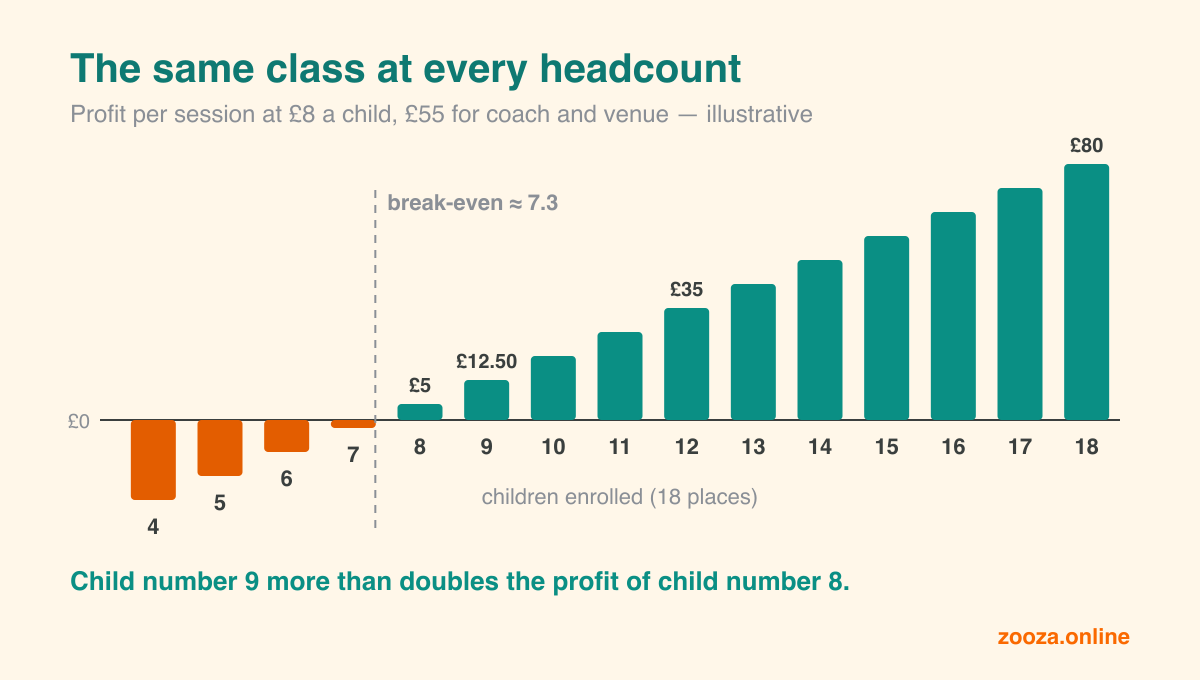
Now look at what one more child does. With eight children, the class makes £5 a session. With nine, it makes £12.50. Nothing else changed: same coach, same hall, same hour on a Tuesday. One extra child more than doubled the profit of that class.
Over a 12-session term, that ninth child is worth £90. If you run twenty classes that look roughly like this one, three terms a year, filling one more place in each is worth £5,400 a year, without a new venue, a new coach or a single extra hour on the timetable.
That is why Nick calls it the key number, and why the easiest growth in most activity businesses is not a new class or a new location. It is the empty places in the classes you already run.
Run it on your own class
The numbers above are invented. Yours will be different, and the shape of the answer is what matters. Put in one of your own classes and see what each extra child is worth across your timetable.
The signals that tell you to act
Occupancy is only useful if it changes what you do on Monday. In our conversation, Nick described a handful of thresholds he watches, and they work as a weekly checklist.
At or below half full, act this week. A class running at 50% or less is the one to promote: a post to local parents, a message to families on the waitlist for a different slot, a free taster. If promotion does not move it, the honest option is often to merge it with another class and give the coach and the hall to something that fills.
Promotion genuinely moves the number. When one leisure operator in the north of England ran a single evening masterclass for one of its group exercise programmes, average utilisation went from 72.1% to 81.8%. Occupancy is not a fixed property of a class. It responds to attention.
A waitlist next to empty places means the offer is in the wrong place. If a class has eight children in 18 places while a waitlist of six builds up elsewhere, demand is not the problem. The time, the venue or the age band is. That is a scheduling decision, not a marketing one. (A seat held by an unpaid registration counts as an empty one here, too. We wrote about how your payment deadline is really a capacity decision.)
A child who has missed three or four sessions is an early warning. Not every absence is a goodbye, but a run of them usually comes before a cancellation. A call at session three keeps more families than a “we miss you” email at the end of term.
Around 16 of 18, start planning the next class. A class that is nearly full is good news with an expiry date. The next family who asks will be told no, and they will find someone else. That is the moment to open a sibling class at a nearby time.
The Friday snapshot
None of this works if the numbers live in a report nobody opens. What Nick described was simpler: every Friday, one short message that says what capacity looks like right now and what needs doing about it.
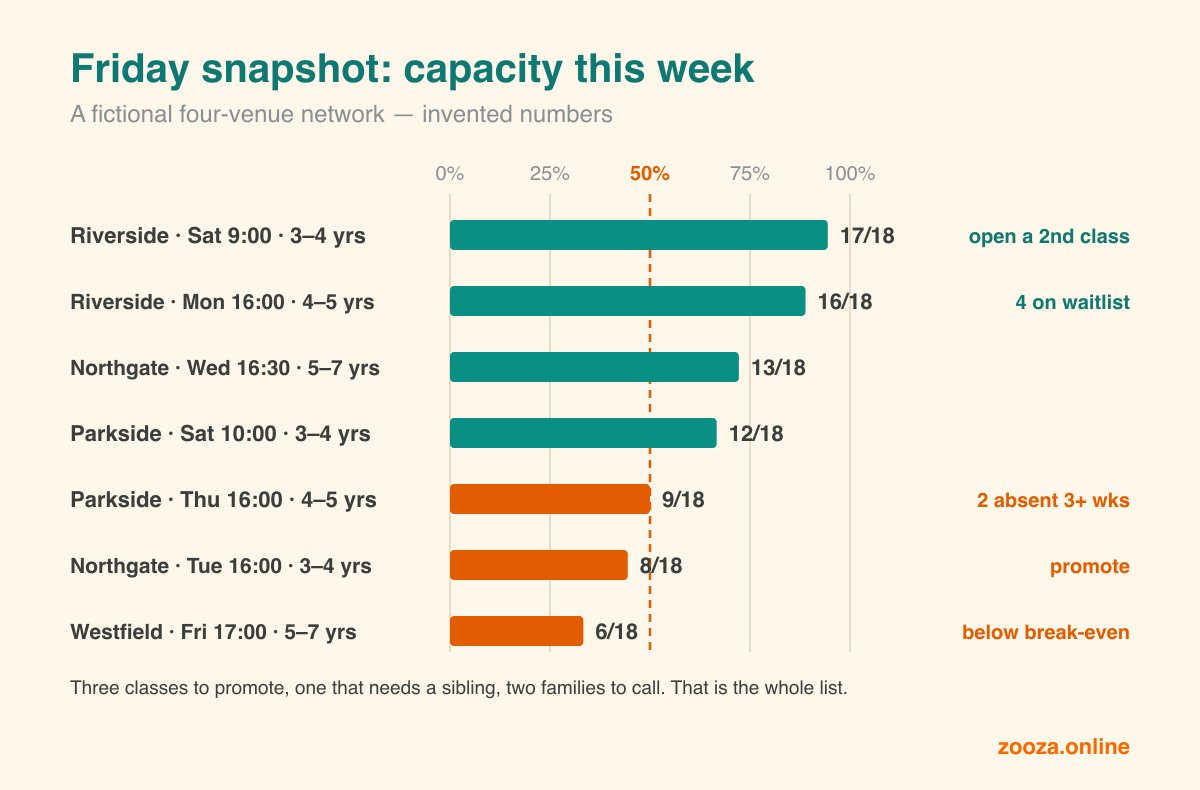
The point of the snapshot is the list at the bottom. Three classes to promote, one that needs a sibling, two families to call. Everything else is fine and can be left alone. We wrote a whole piece on why reporting works best when the numbers come looking for you, exceptions rather than dashboards, and occupancy is the best place to start.
If your Zooza account is connected to an AI assistant through Zooza AI, you can ask for this snapshot directly instead of building it by hand. A prompt along these lines works:
For every class running this term, give me occupancy (enrolled children out of places) per venue. Then list, in this order:
- Classes at or below 50% full.
- Classes at 16 of 18 places or more, and any with a waitlist.
- Children who have missed three or more sessions in a row.
Keep it short and end with a list of the actions to take this week. Use only figures you can actually retrieve. If something is not available, say so instead of estimating it.
Ask it once and see whether the answer is useful. If it is, ask the same thing every Friday.
Where Zooza shows occupancy today
Inside a single Zooza account, occupancy is already on screen. The Classes list shows a fill bar for every class and highlights the ones close to capacity. The Bookings report in Reports shows total capacity, active bookings and capacity utilisation for a billing period, split by enrolled, late enrolment, waiting list and cancelled. And then there is Nick’s Dashboard. We built it with Nick Empson as help for our clients, because Nick is an expert in exactly this field and most operators do not have someone like him on call. It tracks break-even, churn, new enrolments and payments against goals you set, with Nick’s own tips in the setup. You can read about all three in the reports documentation.
For a franchise network, the picture is slightly different. The HQ Network Application reports enrolments, revenue, unpaid debt and royalties across every branch, but occupancy is not one of its metrics. Networks that want capacity as their headline number, which is exactly what Nick recommends, pull it through Zooza AI, or have a custom dashboard built on their Zooza data that puts occupancy per branch, per venue and per class on one screen. That is the dashboard we have been building with a franchise network over the past few weeks, and the Friday snapshot above is what it is designed to produce.
One number, watched weekly
Revenue tells you how the last month went. Occupancy tells you where next month’s profit is hiding, and it does so class by class, which means you can do something about it.
Pick your five weakest classes. Run them through the calculator above. Then ask what it would take to fill two more places in each: a new time, a post in the local parents’ group, a call to the families who drifted away. That is usually a better use of a Friday afternoon than another look at the revenue chart.
What is one more child worth?
Put in one of your own classes. Everything is worked out in your browser and nothing is sent anywhere.
Occupancy
–
Break-even
–
Profit per session
–
Per year, across all these classes
–
If you filled a few more places
| per session | per term | per year |
|---|
Illustrative. Coach and venue costs are treated as fixed per session; your real costs may scale differently.