
Every family that leaves gives you a reason. Most providers never write it down.

Late November. A parent writes: “The Tuesday slot doesn’t really work for us any more, so we’ll stop after this month. Thanks for everything.” You reply that you are sorry to see them go, wish the child well, and close the booking.
Nothing gets written down. In January the family is a number in a smaller total, and nobody remembers whether it was the slot, the instructor, the price or a new baby.
That email is about the most honest feedback an activity provider ever gets. Most providers throw it away.
Leaving is quiet
In 1970 the economist Albert O. Hirschman described the two things an unhappy customer can do in Exit, Voice, and Loyalty. They can speak up, which he called voice, or they can leave, which he called exit. The easier it is to leave, the more people leave without saying anything.
A children’s class with a monthly fee and three other options in town is close to the textbook case. Parents rarely complain about an instructor. It is awkward, their child still has to walk into that room next week, and leaving is easier. So they leave, and the cancellation is the only signal you get.
Which makes it worth reading properly.
What children say, and what parents tell you
The Aspen Institute’s Project Play asked 3,827 young people aged 10 to 17 across all 50 US states about sport, between October and December 2025. The findings, published in April 2026, are blunt about why children stop:
| What former players said | Share |
|---|---|
| Least favourite experience: “I’m not good enough” | 29% |
| Least favourite experience: “Bad coaching” | 21% |
| Were pressured to play when they did not want to | 21% (current players: 9%) |
| Were compared to other players | 18% (current players: 13%) |
| Parents came to games or practices | 58% (current players: 86%) |
Among children still playing, the top reasons were having fun (48%) and playing with friends (47%).
It is a US survey about sport, so it does not tell you anything about your swim school’s churn rate. What it does show is what children leave over: how the activity feels. Whether they think they are any good, how the coach treats them, whether someone is pushing them.
Now go back to that email. “The Tuesday slot doesn’t really work any more.” No study we know of compares the reason a parent gives the provider with the reason the child would give. But it is easy to see why a parent would write the polite, practical version, which upsets nobody. Sometimes the slot really is the problem. Sometimes it is the easiest thing to say.
You cannot tell which from one email. You can from forty, if you wrote them all down.
Three piles, not one number
Most activity providers track leavers, if at all, as one total. That total mixes three very different things:
| Nothing you could have changed | Something you could have changed | Not really a leaver | |
|---|---|---|---|
| Examples | Moved away, aged out, illness, a new baby | Unhappy with the class or instructor, wrong time or venue, price | A booking created twice, an admin correction, a move to another of your own branches |
| Count it as churn? | Yes, but read it apart | Yes. This is the pile to act on | No |
| What it asks of you | Nothing | A change: timetable, instructor, expectations, price | Clean data |
Only the middle pile is yours to fix, and one total hides it. One provider can lose 12% of its families in a term and have almost all of them in the first column. Another can lose 8% and have every one of them in the second. The second provider has the bigger problem, and a single churn figure says the opposite.
The third column causes trouble too. Every duplicate booking an admin ever tidied up is sitting in your churn figure, making it look worse and noisier than it is.
When they left tells you more than why
Two families can give the same reason and mean completely different things:
- Out after zero to two sessions. The class was not what those parents expected. Maybe the age range was off, or the booking page promised one thing and the first lesson delivered another. Or the trial was the whole experience and nobody followed up. That is a trial or first-lesson problem, not a teaching one.
- Out somewhere across the term. Ordinary churn. Now the reason category matters: a cluster of “dissatisfied” around one instructor, or “schedule” around one venue, is something you can act on.
If you only ever record who left, you cannot see this at all. Note how many sessions the child had attended when the booking was cancelled, and the two problems separate on their own.
This is also where attendance comes back in. Families rarely leave suddenly. They stop turning up first, and the cancellation is the last step.
Small numbers lie
One more thing before blaming anyone. Two bookings and one leaver is a 50% cancellation rate. It means nothing.
Most children’s classes are small, so most per-class or per-instructor figures are too small to judge in one term. An instructor with two leavers out of six might be having a bad term. Or two families might have moved house. Wait for a real sample, compare like with like, and treat a single bad term as a question rather than a verdict. Your team will notice whether you do.
What to do this week
- Write your own list of reasons. Five or six, in the words your team would actually use. Make sure “Other” stays small, because everything that lands there is lost.
- Record a reason for every cancellation. The awkward ones too: “unhappy with the instructor” is the reason you most need and are least likely to type.
- Keep the not-really-leavers apart. Duplicates, corrections and moves between your own branches do not belong in your churn figure.
- Ring the early leavers. When a family leaves after one or two sessions, one phone call with one question (“What did you expect that we didn’t give you?”) is worth more than a survey form.
- Look in January, before you plan the next term. Which pile is biggest, and where does the middle one come from? A venue, a time slot, an age group, a first lesson?
None of this needs software. A spreadsheet with four columns (date, family, reason, sessions attended) will do it. The hard part is not the tool. It is writing it down every time, including on a busy Friday.
How this works in Zooza
Since the end of October 2026, cancelling a booking in Zooza requires a reason, and Zooza saves who cancelled it and when. You set up the list yourself in Settings → General → Cancellation reasons: rename the built-in reasons into your own words, add your own, hide the ones you do not use.
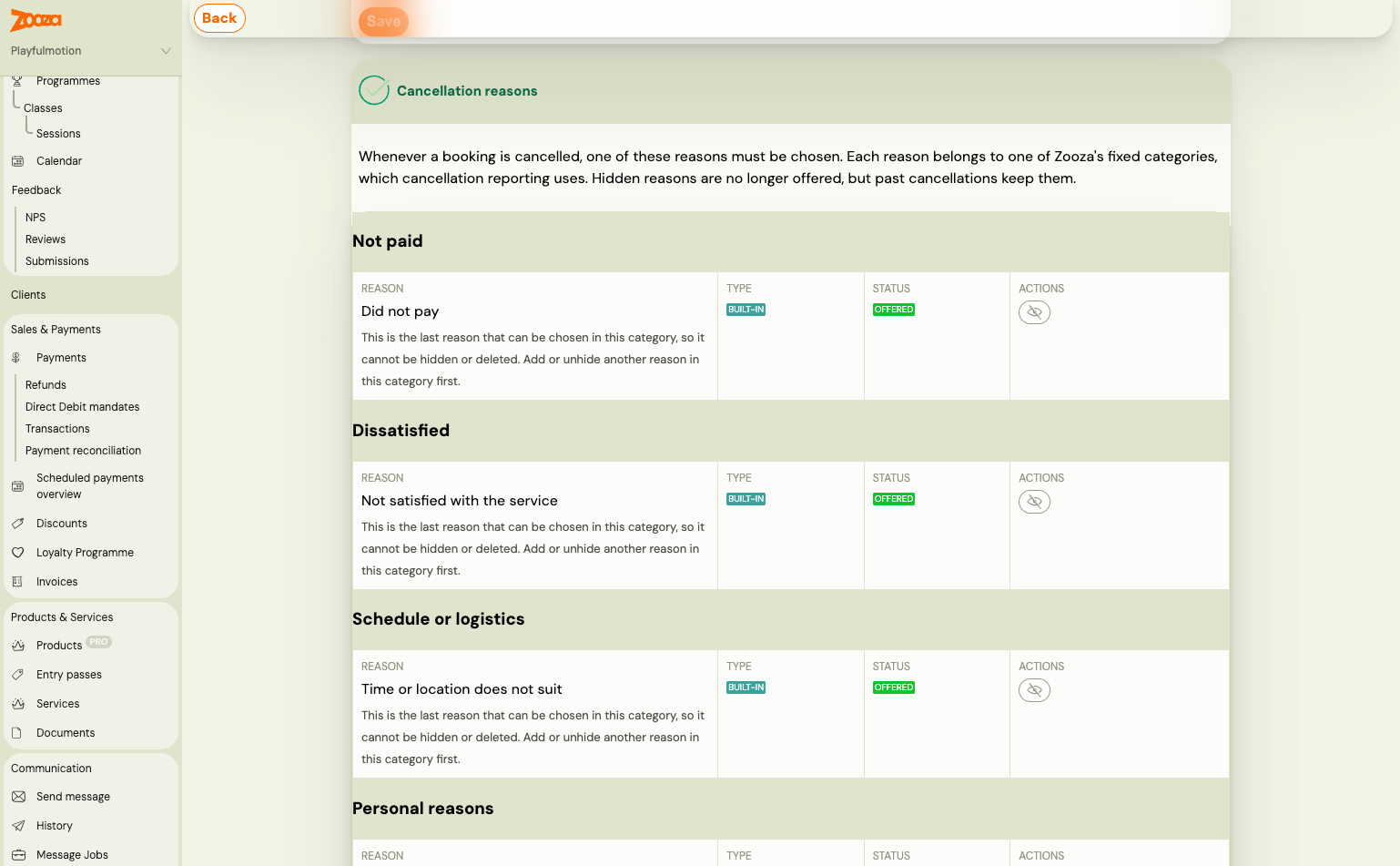
Each reason sits in one of Zooza’s fixed categories: not paid, dissatisfied, schedule or logistics, personal, price, other. Reports count by category, not by your wording, so you can rename a reason without breaking last year’s numbers. Admin corrections and transfers to another unit of your network are counted but kept out of the rate, which is the third pile above, built in.
The Cancellations report (in Reports & Insights → Reports, currently in beta) then shows:
- your cancellation rate against the previous period, with the fraction behind it, so 50% from two bookings is visible for what it is;
- a breakdown by programme, class, instructor, venue, day and time, payment method or month;
- Sessions attended before cancelling, the timing view from this article;
- Where to look, which names a hotspot in plain words, such as “Programme: people leave in the first sessions”. It stays quiet below 15 bookings, 3 cancellations, or a rate less than twice the comparison, so it does not cry wolf on small classes.
Franchise networks can manage one list of reasons for every unit, so head office compares like with like across branches.
The report points you to where to look. Deciding what to change is still yours. The full setup, including how renaming and hiding reasons affects past cancellations, is in the cancellation reasons guide.
The email, read properly
Go back to the parent who wrote about the Tuesday slot. Recorded properly, that email becomes one line: schedule, 9 sessions, Tuesday 17:00, venue B. On its own it is nothing. In January, next to eleven others that say schedule, Tuesday, venue B, it tells you to move a class.
And if those eleven others say dissatisfied, 2 sessions, it tells you something less comfortable, and more useful.