The person who will run your next location is probably already in your class

Families in the next town have started asking. A mum drives forty minutes each way to your Saturday class and tells you there are five more like her at the school gate. You could find a hall by Friday.
What you cannot find by Friday is the person who will stand in front of those children every week and care about them the way you do.
That is the part of growth nobody budgets for. In June 2023, 65% of UK learn-to-swim providers said a shortage of teachers was stopping them from growing, and close to 12,000 of the sector’s 73,000 jobs were vacant (STA and Swim England, 2023). It is not that the job is unpopular: 96% of swimming teachers say they enjoy it (Swim England). On the franchise side, 44% of Australian franchise brands named recruiting franchisees as a challenge in 2023 (Franchise Council of Australia). The children are there. The people are the bottleneck.
The encouraging part is in the stories of the brands that solved it. Read enough of them and one pattern keeps coming back: the person who ended up running the new location was usually already in the room. A parent on the poolside bench. An assistant. A teacher of fifteen years. A customer who moved abroad and took the programme with her.
“Some of the franchise owners we work with tell us that more than 60% of their franchisees are mums who first came to their classes as customers.”
Michal Dodok, co-founder of Zooza
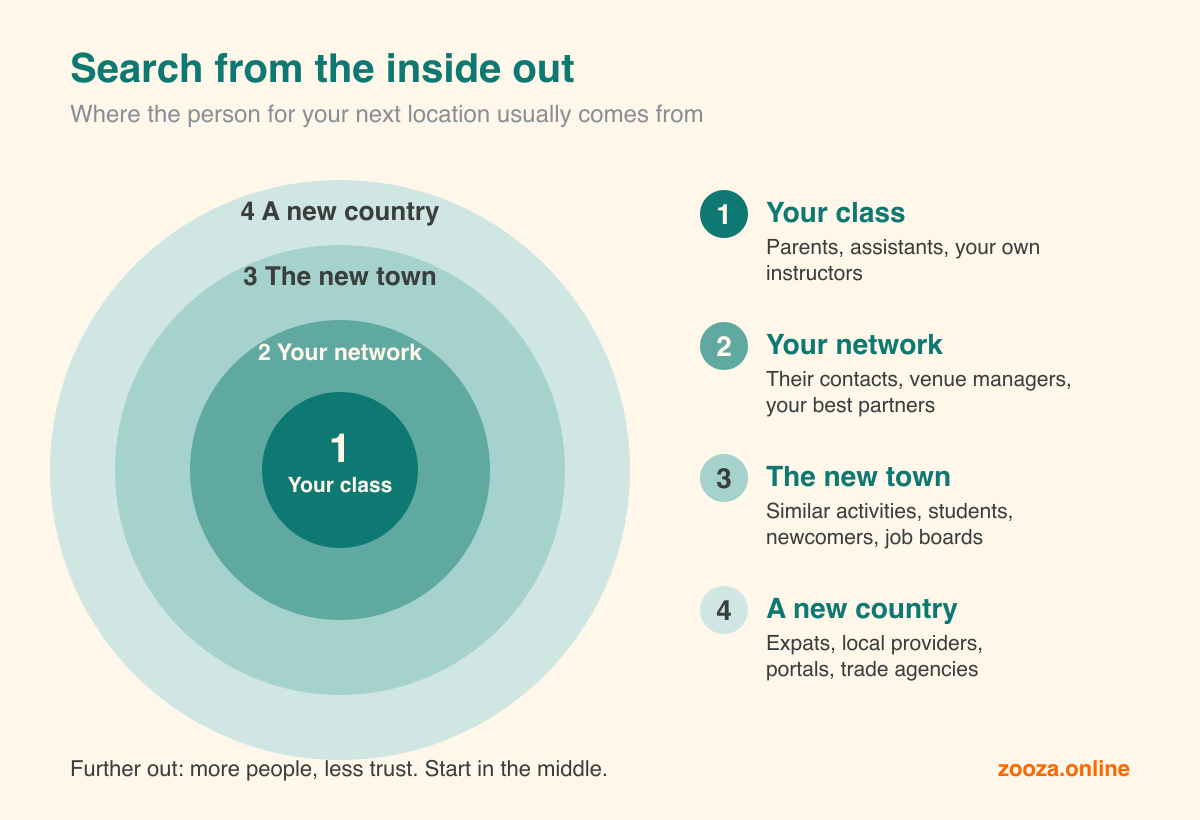
So this guide works from the inside out. Start with your own class, then your network, then the new town, and only then a new country. Each ring further out is easier to reach in numbers and harder to trust. After the 30 ideas come two things that decide whether any of them work: how to choose the person, and the paperwork if the new location is abroad.
Ring 1: the people already in your room
1. Say the invitation out loud, in class
Parents who have sat through thirty weeks of lessons know your programme, your families and an instructor’s working day better than any applicant from a job ad. The brands that grew this way did not wait for those parents to apply. Somebody asked them.
Faye Davoren was at a Monkey Music class with her little boy when she “got talking to the franchisee and she suggested there might be a local opportunity” (bfa). At Hartbeeps, the local franchisee emailed Laura about a teaching job a week after her first class. Laura trained, bought into a partnership, then her own franchise, and now runs 77 classes a week (TotalFranchise). Helen Doron’s master franchisee in Poland, who runs 62 centres, puts it plainly: “Most of my new Learning Centre franchisees are either our teachers or parents that observed their kids learning with us” (Global Franchise, 2021, sponsored profile).
Make the invitation visible. One line in the end-of-term email. A poster at the venue that asks “Could you run this in your town?” And a sentence your instructors are comfortable saying when a parent lingers after class.
2. Build a ladder, and give every rung a name
Nobody climbs a ladder they cannot see. Charlie Goodenough was a club swimmer who, after her first child in 2008, “couldn’t think of any profession where I could successfully work around my family”. She started as a poolside assistant at Puddle Ducks while her mum minded her son, paid for her own teacher training, and watched the local franchisee run the business. By 2016 she was teaching more than 500 children a week across seven pools (Puddle Ducks). Ellie Cawdell came to Puddle Ducks lessons with her first child in 2011, bought a franchise in 2013 as a part-time plan, and now leads a team of 35 teaching about 1,200 children a week (Puddle Ducks, 2026).
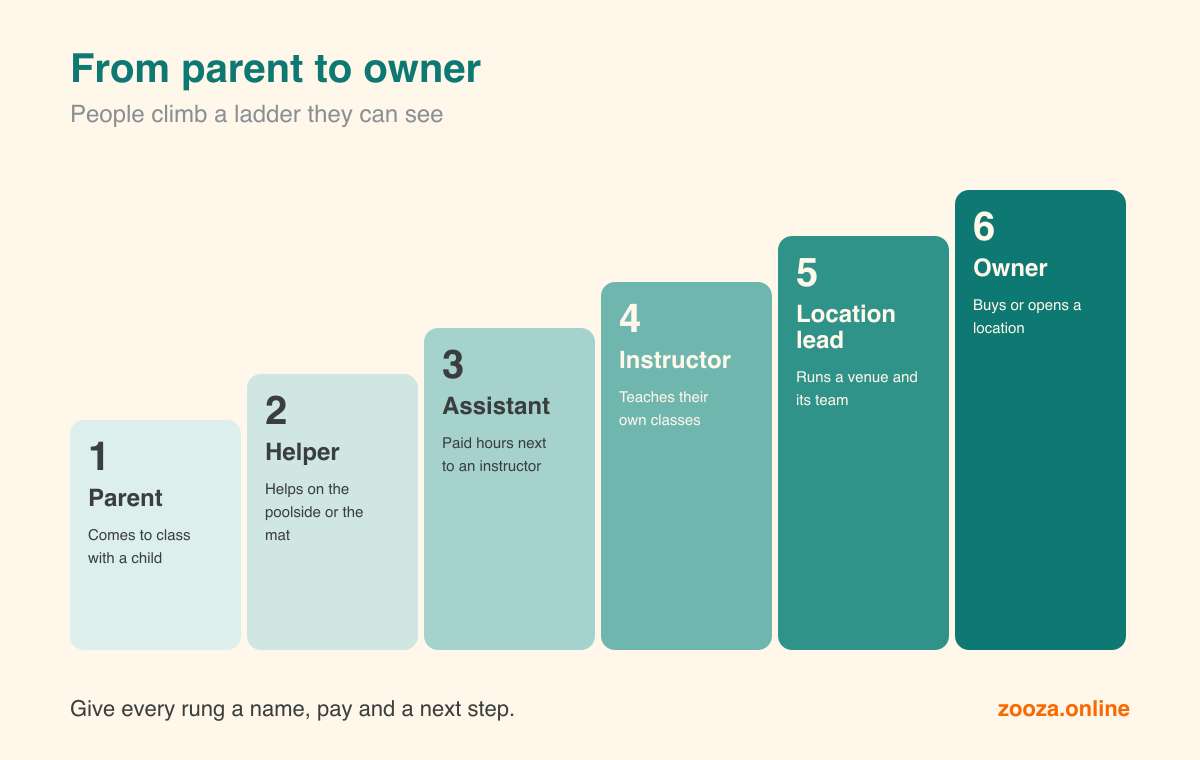
Write your ladder down, attach pay to every rung, and tell people where it leads. Then check the rules. In England and Wales, from 1 September 2026, supervised assistants who help regularly also need an enhanced DBS check (GOV.UK), and similar checks are tightening across Europe (see the paperwork section below). Build the check into the timeline rather than discovering it at the end.
3. Plan succession before anyone leaves
When an owner retires, the most natural buyer is often the instructor who has taught there for years. In July 2026 the British Franchise Association profiled three Stagecoach teachers who bought the schools they had taught at for 13 to 17 years. Emma Furnell said “it felt important that the school was taken on by someone who already understood its community”, and Stagecoach’s CEO added that “there’s already a community, a team and a trading history in place” (bfa, 2026).
This will matter more, not less. In the bfa’s 2024 survey, 65% of UK franchisors expected to resell at least one existing unit within twelve months (Franchise World). Tell your long-serving instructors now that this path exists, so a sale does not turn into a search for a stranger.
4. Hire the character, teach the craft
Almost every children’s brand whose recruitment pages we read says the same thing: experience in the activity is optional. Puddle Ducks writes “You don’t need experience in swimming or franchising”, and its franchisees come from “accountancy, law and teaching” (Puddle Ducks FAQ). Monkey Music checks whether a candidate shares its “ethos and values” alongside business and music skills, and a former retail area manager with no formal music training has run more than 30 classes a week for them (What Franchise, 2020).
That only works if you can teach the craft yourself, which is why the strongest evidence in the scarcest profession comes from academies. The Swimming Teachers’ Association funded free teacher courses and, by the end of 2022, had produced 900 new teachers, 86% of whom went into work (STA, 2023).
Free training on its own is not enough, though. A YMCA in Ohio offered free lifeguard training with a guaranteed job and got zero applicants (Fox 8 via Yahoo News, 2024). Pair the course with guaranteed hours and clear pay, and say both in the first sentence of the offer. Why instructors leave or never join is a topic of its own, covered in our guide to keeping lecturers.
5. Call back the boomerangs
The instructor who left two years ago because of a new baby or a new job is a candidate who already knows your programme. In the UK Coaching workforce survey, 26% of inactive coaches said they would like to return. They had left mostly for lack of time (34%) or because they moved (18%), and what would bring them back was pay and a refresher course, not an appeal to good will (UK Coaching, 2017 data).
Offer one or two fixed slots a week rather than a full timetable, and a short refresher before the first class. It is a small ask, and small asks get a yes.
Ring 2: your network
6. Ask for one name, not for a share
“Please share our job ad” produces likes. “Who is the warmest person you know in Brno who’s great with toddlers?” produces a name.
The data behind this comes from larger employers, so treat it as a direction rather than a promise for a five-instructor business. Across 38 million applications between 2021 and 2024, referred candidates were about 1% of applicants, but 40% of them reached an interview, against 3% of everyone else (Ashby). In 2024 data reported by SHRM, referrals made by email worked better than shares on social media, which brought 30% of referrals but only 14% of hires (SHRM).
Franchisors underuse the same channel. In the US Annual Franchise Development Report, referrals were the third-best source of signed franchisees in 2023 (AFDR 2023) yet got only 7% of recruitment budgets (AFDR 2024). Ask your instructors, parents and partners one at a time, in person or by email.
7. Ask the venue manager
The person who runs the sports hall, the community centre or the kindergarten knows exactly who teaches there on Tuesday evenings and who is reliable. Nobody has studied this as a recruitment channel. It costs a coffee and a question, which makes it one of the cheapest ideas on this list.
8. Ask your best partner first
Before you look for strangers, ask the people who already run your programme well whether they would like to run more of it. Ellie Cawdell, the customer who became a franchisee, now runs five territories (Puddle Ducks, 2026). The same logic opens doors abroad, as you will see below.
Ring 3: the new town
9. Instructors of similar activities, approached fairly
The dance teacher who teaches at three studios, or the swim coach between contracts, already has the skills and often a following. Approach them openly and fairly: not in the middle of a term, not with their current employer’s client list, and with respect for any non-compete they have signed. Then offer what they do not have where they are: their own brand, more hours, a share of the business, or a programme and system that are ready on day one.
10. Students who need hours and experience
Students of education, sport science and music, and trainee teachers, often have free afternoons and need practical experience. Talk to faculty careers offices, offer a placement or internship arrangement where the university recognises one, and give students a clear path from assistant to instructor. A student who teaches with you for three years is a strong candidate to lead a location after graduating.
11. Tutor and instructor marketplaces
Platforms such as Superprof list dance, music and sports teachers by city. Contacting them needs a paid Student Pass ($49 a month), and contact details are shared only once the teacher accepts (Superprof). Be upfront in the first message that you are offering work or a partnership, not booking a lesson. Anything else is misleading and probably against the platform’s terms. Local tutoring sites, such as Doučma.sk in Slovakia, lean towards school subjects and languages, so they suit language programmes better than swimming or dance.
12. People who have just moved to town
Someone who has just moved has time, wants to belong somewhere, and may have left a similar job behind. Moving was the reason 18% of inactive UK coaches gave for stopping (UK Coaching, 2017 data), which means another town gained a coach who has not been asked yet. Look in “new in town” and expat groups, and ask local estate agents and international schools who has arrived recently.
13. Parents on long parental leave
Slovakia has 192 weeks of paid parental leave per child, the most in the OECD, where the average is 65 (OECD data via Voronoi). That creates a group of parents, mostly mothers, who are out of full-time work for years and may welcome a few morning hours of baby or toddler classes. We found no study that shows this channel working at scale, so treat it as an idea to test. Check first how much can be earned alongside parental benefits in that country.
14. Job boards, with fast screening
Job boards are not dead. In Slovakia, Profesia.sk counted 40 applicants per job ad in the first quarter of 2026, up from 29 a year earlier (SITA). The bottleneck is sorting, not reach. Decide the screening before the ad goes live: a ten-minute phone call, then a trial lesson for the best three.
15. A recruitment page with real partner stories
In the 2023 US Annual Franchise Development Report, franchisors’ own recruitment websites were the leading source of signed deals (AFDR 2023). Your page does not need to be fancy. It needs real partner stories with names and photos, an honest description of a working week, what it costs, what past locations have achieved (labelled as past results, not promises), and how selection works. National franchise portals such as franchising.sk, franchising.cz or Franchise Direct’s children’s category are a useful extra, not a replacement.
16. Build the waitlist before you recruit
Run a small local ad in the new town, “We’re coming to Nitra. Join the list”, and collect families before you have a person. Two things happen. You learn whether the demand is real. And when you meet a candidate, “40 families are already waiting for you” is the strongest sentence you can say, because it takes away the fear of starting from zero.
17. Hold a double open day
One event, two audiences. In the morning, a free demo class for families in the new town. Straight after it, a coffee with the founder for anyone who might want to teach or run the location. The candidates see real children and real parents, you see the candidates with children, and the same effort tests demand and finds people at once.
18. Meet in person, because that is where the decision happens
The US franchise data is striking here. Of raw enquiries, 1.8% end in a signed franchisee. Of qualified leads, 13%. Of the people who come to a discovery day, the in-person visit to head office, 73% sign (AFDR 2024). Those are large US brands, where one signed franchisee costs an average of $11,639 in recruitment, so read the shape rather than the amounts.
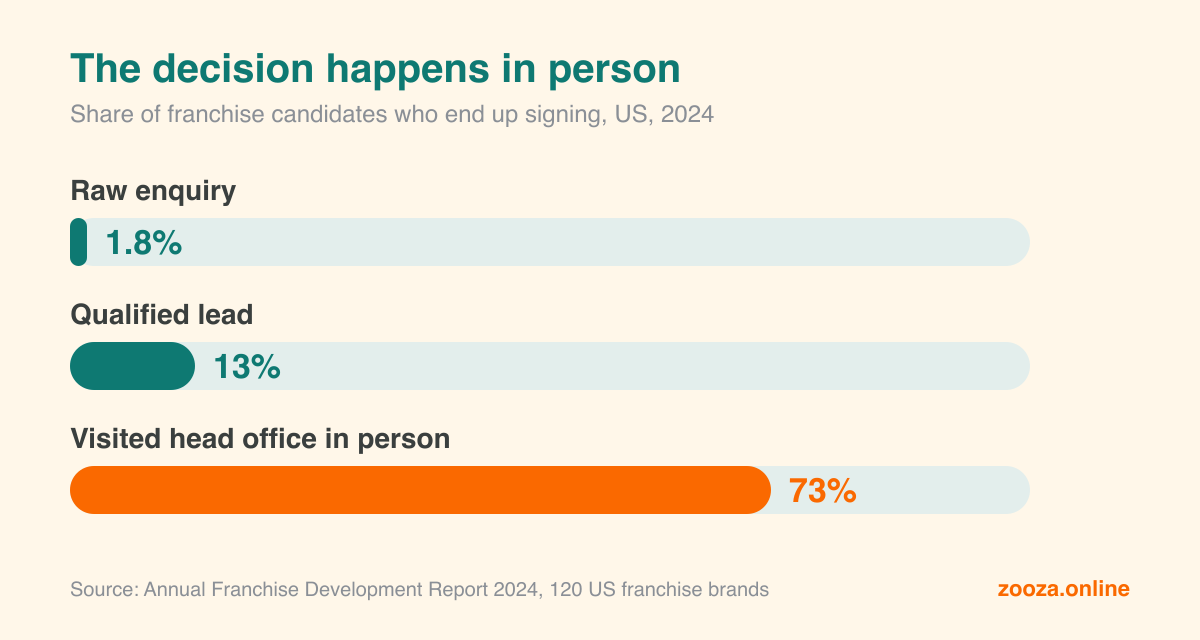
Put your effort into getting a few of the right people into a real class with you, not into more enquiries.
Choosing the person: character before the CV
Finding someone is half the job. The other half is the interview, and it deserves far more care than most owners give it. Skills can be taught in weeks. Character cannot be taught at all: the drive, the hunger to build something, the warmth with a nervous three-year-old and a cross parent, and values that match yours. When that is wrong, nothing you train fixes it.
Water Babies’ founder Paul Thompson put it simply when describing who they looked for: “We wanted to find people who have our vision” (Global Franchise, 2020). The European Code of Ethics for Franchising asks franchisors to select partners on skills, finances and personal qualities, not just ability to pay (EFF Code of Ethics).
Write your values down before you interview anyone
Interviews go wrong when nobody has decided what “the right person” means. That decision is your values, and it is the one piece of management theory we push hardest with the owners we work with: every company should have its core values written down, and every people decision should run through them.
The method is well tested. Jim Collins showed in Good to Great that the companies that made the leap “first got the right people on the bus (and the wrong people off the bus)” (Jim Collins). EOS, the operating system from Gino Wickman’s book Traction, turns that into a routine: three to seven core values, “discovered, not invented” in the founders and key people who already make the business work (EOS Worldwide). Then you score everyone, the current team included: + lives the value, +/− sometimes, − does not (EOS People Analyzer).
Our rule of thumb: a +/− is fine and means a conversation. A − means a planned parting, because character rarely changes in the short or medium term. And everyone sees it. When one person does not fit, the team notices long before the owner acts, and the problems that follow cost more than the vacancy. A meta-analysis of 172 studies backs this up: people whose values fit their organisation are more satisfied (correlation .44), more committed (.51) and less likely to plan to quit (−.35) (Kristof-Brown, Zimmerman and Johnson, 2005).
One children’s course network we work with writes its values as behaviour. Lightly edited to keep it anonymous: Leadership: “We lead our daily work the way we lead children in class: we take responsibility, show the way and tackle problems instead of passing them on.” Teamwork and respect: “We would rather move forward together than alone. The business grows only as fast as its people.” That is the bar every new instructor and every new location partner is measured against. Our separate guide shows how to find your values and hire by them, step by step, with interview questions for each value.
Look at the pair, too. A new location needs someone with the vision to build it and someone who gets things done, and they are not always the same person. We wrote about that balance in the visionary and the executor.
Good selection has steps, and each one asks for a little more commitment. Puddle Ducks publishes its own: an enquiry form, an introductory call, a discovery call and a meeting with the team, a business plan with a visit to head office, and only then a deposit (Puddle Ducks FAQ). Three steps are worth adding for children’s activities.
19. An audition class
Before anything is signed, the candidate teaches one real class, with you or an experienced instructor in the room. You learn more in forty minutes than in two interviews, and so do they.
20. A shadow day
The candidate spends a full working day with an owner or instructor: the early set-up, the admin between classes, the parent who wants a refund, the venue that double-booked the hall. Some will love it. Some will discover it is not for them, which is the cheapest possible way for both of you to find out.
21. A call with an existing partner, without you on the line
Let the candidate ask one of your current partners anything. It works as a sales tool only if your partners are happy, which is the point. Back in 2010, Franchise Business Review found that brands with highly satisfied franchisees grew six times faster than those with dissatisfied ones (Franchising.com). The figure is old. The logic is not.
Questions that tell you more than a CV:
- Why this, and why now?
- Tell me about something you built from nothing.
- A parent complains loudly in front of other parents. What do you do?
- How many hours a week can you really give, and on which days?
- Who do you know in this town?
- What would make you give up in year two?
And the warning signs: a candidate who talks only about money, who wants to change the programme before learning it, who knows nobody locally, or who pushes to sign quickly. The hardest one sits on your side of the table. If you need the fee more than you need the right person, you will say yes to the wrong one.
Going abroad: the same rings, longer distances
Abroad, the risk is rarely that you find nobody. It is that you find the wrong person in the wrong country.
Water Babies lived through both outcomes. About five years after launch, a teacher approached them about Australia. The Sydney licence was withdrawn after roughly a year, and founder Paul Thompson later called it “an example of how not to do it”: the company was too young and the market too far away. In 2008 a couple from Dublin got in touch. On advice, Water Babies started modestly in Ireland, and it became the fastest-growing market in the company’s history, with 1,000 clients a week within a year (Global Franchise, 2020). The franchise lawyer Ned Levitt lists “choosing countries because of an inbound approach from a foreign resident” among the root causes of failed expansions (Global Franchise, 2022).
The lesson is narrower than “never answer an approach from abroad”. An approach from a stranger in a far-away country, when you are not ready to support them, is risky. An approach from someone who already knows you, in a country close to home, is the strongest pattern in the whole research.
That is also why character and values matter even more abroad. You cannot drop by on a Tuesday. The partner speaks a language your head office may not, deals with parents you will never meet, and is your brand in that country. People who already know and love the programme, such as customers who moved or partners who relocated, start with the most important thing already in place.
22. Customers and partners who move countries
Kumon’s first centre outside Japan opened in New York in 1974, and “initially, most students at this Center were the children of Japanese expatriates”. Until 2004, Kumon grew abroad largely by receiving offers from local parties (Kumon Group). Little Kickers’ CEO describes the first of three routes into new countries in one sentence: “Little Kickers franchisees have moved countries and decided to take the brand with them” (Global Franchise, 2024). Helen Doron’s national franchisee in Croatia found the programme as a parent in Budapest, and the Lithuanian franchisees heard about it from a friend who had seen it in Romania (Global Franchise, 2021, sponsored profile).
Ask your families and instructors who is moving abroad or has family there. It is a strange question to ask, which is exactly why nobody else is asking it.
23. Your best home partner goes abroad
Razzamataz Theatre Schools offered international master licences for years. The partner who finally opened Ireland was not a foreign investor but Jessie, who had run several of its schools in Essex since 2017 and moved to Ireland with her husband (Franchising.com, 2026). Helen Doron’s German master franchisee came in because his wife had taken the teacher training (Global Franchise, 2021).
24. A local provider who already runs children’s programmes
A pattern shows up in Central and Eastern Europe that English-language franchise literature rarely mentions: the best first partner in a new country often already runs another children’s education programme. Edukido, a Polish brand, got its first foreign partner when a Croatian who had run a mental-arithmetic franchise for two years found it on the portal Franchising.hr and bought the national licence (franchising.eu, 2021). Spain’s Kids&Us started by licensing its method to other language schools about three years in, before moving to full franchising (Global Franchise, 2022, sponsored profile).
Such a partner already has customers, rooms, staff and an understanding of local parents. Approach language schools, activity clubs and kindergartens with a licence that adds your programme to what they already do.
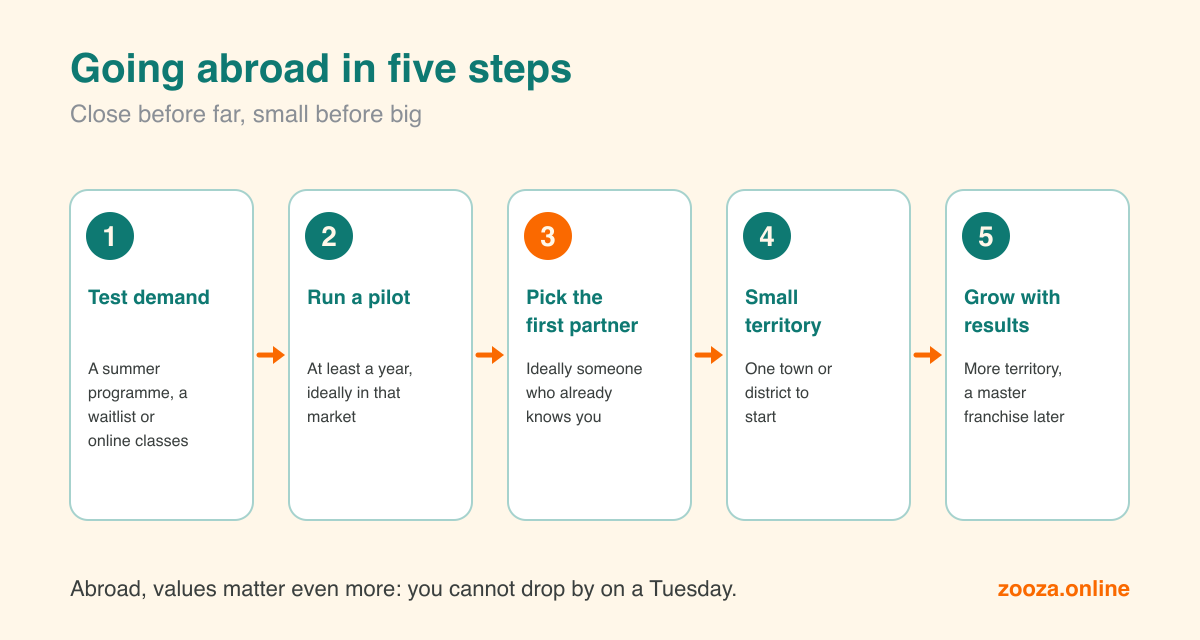
25. Close before far
From Slovakia, that means Czechia, Austria, Hungary or Poland before Spain. From the UK, Ireland before Australia. Water Babies’ contrast between Sydney and Dublin is the clearest case in the research. Similar language, similar school calendar and a three-hour drive make it possible to visit, help and fix things, which a new partner will need.
26. Diaspora communities
Slovak parents in Britain organise weekend activities so their children keep the language and culture (RSI, 2019). That is a ready-made community with parents, rooms and trust. We found no children’s brand that entered a country this way, so it is an untested idea. It is also an obvious one for a programme that already runs in Slovak or Czech.
27. Test demand before you recruit
Before Helen Doron’s French master franchisee officially opened in Paris, she ran a summer programme. In September 2016 she opened with 30 children enrolled, 50 pre-registered and more than 100 enquiries (Helen Doron). A local-language landing page, a modest ad budget and a waitlist (idea 16) do the same job on a smaller scale. So does a holiday camp, or an online class for families who already know you.
28. Franchise portals and exhibitions in the local language
Edukido’s first foreign partner found it on a portal in his own language. One company runs the national portals franchising.cz, franchising.sk and franchising.pl, along with Hungarian and Croatian versions (franchising.cz), and Germany’s FranchisePORTAL lists 1,474 concepts, including learning and leisure categories (franchiseportal.de). Exhibitions are bigger than most owners expect: Franchise Expo Paris drew 31,937 visitors in 2026 and returns on 13 to 15 March 2027 (FFF). The bfa-backed UK shows are at Olympia London on 29 to 30 January 2027 and at the NEC Birmingham on 1 to 2 October 2027 (bfa).
Go to an exhibition as a visitor first. Edukido’s partner roadshow in Hungary drew 20 interested people and signed one, with low awareness of franchising and weak English as the main barriers (franchising.eu, 2023).
29. Trade agencies, with a precise brief
Export agencies will search for partners abroad, and many owners of children’s businesses never think of them. Slovakia’s SARIO lists tailored partner search among its key services (SARIO). CzechTrade’s Market Entry service gives up to 16 hours of a foreign office’s time in the EU (24 outside it), including a letter in the local language (CzechTrade). Poland’s PAIH offers free advice in more than 70 markets and builds lists of potential partners (PAIH).
These agencies are built for exporters of goods, so the brief has to be exact: “Find dance schools, swim schools, kindergartens or clubs in Manchester or Vienna that could run our programme under licence.” Expect to explain how the model works.
30. Start small and grow with performance
Experts on international franchising keep recommending the same sequence: a small first territory that the partner expands by results, and often direct entry first, with a master franchise later (Global Franchise, 2022; Kelepouris, 2023). Little Kickers runs 18 of its 25 countries directly from head office and seven through master franchisees (Global Franchise, 2024).
Localise properly while you do it. Edukido ships materials in English and insists its partners speak it (“We will not move without it”), which narrowed the people it could sign in Hungary (franchising.eu, 2021; franchising.eu, 2023). The instructor needs the local language, and so, eventually, do the materials.
Let the right people find you
Searching is only half of recruitment. The other half is being easy to find for the people who are already looking for a franchise, a teaching job or a programme to add to their club.
- Partner stories and reviews. Candidates check what your current partners say, on your site and when they call them. Publish real stories with names and photos, with permission, and keep them current.
- Local press. “Local mum opens a baby ballet class” is a story regional papers and town websites still print, as a Bristol community site did for one babyballet franchisee. Every story like that also recruits the next person.
- Search and AI answers. Write pages that answer what candidates type: what it costs to open your programme in their country, what a week looks like, what support they get. Honest numbers, labelled as past results, are what the European Code of Ethics asks for anyway.
- Social media and franchise communities. In the 2024 AFDR, 46% of the surveyed franchisors had closed a deal through social media (AFDR 2024). Show up where people talk about franchising: association events, LinkedIn, podcasts and the franchise portals’ own content.
The paperwork abroad
This is general information, not legal advice, based on sources read on 15 November 2026. Before signing in any country, talk to a local lawyer.
The first trap is the name. Many children’s brands call their partners licensees or partners, but several laws look at what the contract does, not at what it is called. Italy’s franchise law applies to the contract “comunque denominato”, however it is named (Normattiva), and France’s Loi Doubin applies whenever a brand is provided together with exclusivity (Article L330-3).
How long before signing, per the sources below and a May 2026 IBA/IFA working paper (IBA/IFA, 2026):
| Country | Specific franchise law | Disclosure before signing or payment | Worth knowing |
|---|---|---|---|
| France | Yes (Loi Doubin) | 20 days | Also 20 days before any upfront payment |
| Spain | Yes (Law 7/1996) | 20 days | The national franchisor register was abolished in 2018 (AEF) |
| Italy | Yes (Law 129/2004) | 30 days | Written contract, at least three years, a formula already tested on the market |
| Belgium | Yes (Code of Economic Law, Book X) | 1 month | The franchisee can seek annulment within two years |
| Netherlands | Yes (since 2021) | 4 weeks | No signing, no payments and no changes during that time (Pinsent Masons) |
| Sweden | Yes (2006:484) | “In good time” | Usually read as about 14 days (lagen.nu) |
| Romania | Yes (Ordinance 52/1997, amended 2019) | A standard disclosure document | At least one year running a pilot unit before franchising (bpv Grigorescu) |
| Germany | No | The German Franchise Association expects at least 10 days | Courts are strict, especially with first-time founders; information in German (DFV) |
| Austria, Poland, Czechia, Slovakia, UK | No | No fixed period | General rules on honest pre-contract information still apply; Poland’s draft 14-day law has stalled since 2023 |
A rule of thumb that meets every period above: at least 30 days between handing over the information pack and signing, and no money taken before that. The European Code of Ethics for Franchising adds three things worth following everywhere: run the concept for at least a year in a pilot unit in that market before franchising there, keep earnings claims objective and never misleading, and offer the contract in the partner’s language (EFF Code of Ethics).
Background checks for working with children are tightening across the region, and they now reach exactly the helpers and assistants from ring 1:
| Country | What is required | From |
|---|---|---|
| England and Wales | Enhanced DBS with the children’s barred list for regular coaches and instructors, now including supervised assistants (GOV.UK) | 1 Sep 2026 |
| Poland | Checks of the sex offenders register and criminal record before hiring, even on civil contracts, a declaration of every country lived in for 20 years, and published child-protection standards (KPMG) | 15 Feb 2024 |
| Slovakia | Sports professionals in youth sport submit a criminal record extract every year by 31 March (Slov-lex, Act 104/2025); whether this reaches dance, music or language classes outside sport is unclear | 2025–2026 |
| Czechia | A new “dětský certifikát” (children’s certificate) record (epravo.cz) | 1 Jan 2027 |
| Germany | Extended certificate of good conduct (erweitertes Führungszeugnis), required for clubs under agreements with the youth welfare office and strongly recommended otherwise (Sportjugend Hessen) | in force |
| Romania | Certificate of behavioural integrity for instructors of camps and after-school activities, volunteers included, valid six months (Bugetul.ro) | Jul 2026 |
Three more things to sort out before the first partner abroad:
- Trademark. An EU trade mark costs €850 for one class and covers all 27 member states, but not the UK, which needs its own filing (CITMA; GOV.UK).
- How parents pay. UK Direct Debit processed a record 5 billion payments in 2025 (Pay.UK). In the Netherlands, 71% of online purchases go through iDEAL (Betaalvereniging). Poland’s BLIK has 20.7 million active users but handled only 1.6 million recurring payments in 2025, so monthly fees there still lean on cards or direct debit (Bank.pl).
- Non-compete clauses. Under the EU vertical block exemption, a non-compete during the contract is covered for up to five years, and after it for one year, limited to the partner’s premises (Regulation 2022/720). A ban covering a whole city or country after the contract ends is outside that safe harbour.
Ready for a new location?
Tick what is true today:
- Our core values are written down, and we have scored our current team against them.
- We can describe our ideal partner in one sentence, values included.
- The invitation to teach or lead is visible in our classes and our end-of-term emails.
- Our ladder from parent to owner has names, and pay at every rung.
- We have a training course, and we can guarantee hours to the people who finish it.
- We have asked our instructors, parents and partners for one name each.
- We have a waitlist of families in the new town.
- Our selection has steps, including a shadow day, an audition class and a call with an existing partner.
- Background checks are in the timeline, not at the end of it.
- Abroad: a pilot, a trademark, and an information pack in the local language at least 30 days before signing.
- We could say no to the wrong person, even if we need the fee.
Where Zooza fits
A new partner should be teaching in the first month, not building an admin system. In Zooza every plan includes unlimited locations with no per-location fee, so a new location opens inside the same system as the rest of your network: the same programmes, booking forms and payments, with its own classes, instructors and venues. Head office sees every location in one franchise and multi-location dashboard. If you are a franchisor choosing a system, our guide to what franchisors ask before they buy one goes through the questions.
Back to the mum at the school gate
Go back to the mum who drives forty minutes to your Saturday class. She already loves the programme. She knows five families who want it. She has told you so twice.
You were looking for a hall and a stranger. Next time she lingers after class, ask her whether she would like to run it.