Write your values down before you hire anyone else
Every team has one. The instructor the children adore, who is late again on Saturday, talks about colleagues in front of parents, and is somehow never there when the hall needs tidying.
Everyone else has noticed. They are not waiting for the instructor to change. They are waiting to see what you do.
That moment is about values, even if nobody calls it that. Skills show on a CV. Values decide whether a person makes the people around them better or worse, and in a business that grows to new locations, they are the only thing that travels when you are not in the room.
We push one piece of management theory harder than any other with the owners we work with: write your core values down, and run every people decision through them. Here is how, and why it matters more than it sounds.
Why values come first
The idea is not new, and it has held up. In Good to Great, Jim Collins found that the companies that made the leap “first got the right people on the bus (and the wrong people off the bus)” and only then decided where to drive it (Jim Collins). EOS, the Entrepreneurial Operating System described in Gino Wickman’s book Traction, made it a routine that small companies can actually run: “Every people decision in EOS runs through Core Values first” (EOS Worldwide).
The research agrees. A meta-analysis of 172 studies found that people whose values fit their organisation are clearly more satisfied with their job (a correlation of .44), more committed to the organisation (.51) and less likely to plan to leave (−.35) (Kristof-Brown, Zimmerman and Johnson, 2005). In the studies that measured fit on values alone, the link with commitment was even stronger (.68).
For a children’s activity business, add one more reason. Parents do not buy your timetable. They buy how the person in front of their child behaves on a wet Tuesday in February. Values are how you make that the same in every class and every location.
Step 1: discover your values, do not invent them
Values written in a workshop tend to come out as Respect, Quality, Innovation, the same words on every office wall. They describe nobody, so they decide nothing.
EOS puts it bluntly: “Core Values are discovered, not invented” (EOS Worldwide). They already live in the founders and the key people who make the business work. Your job is to find them and write them down.
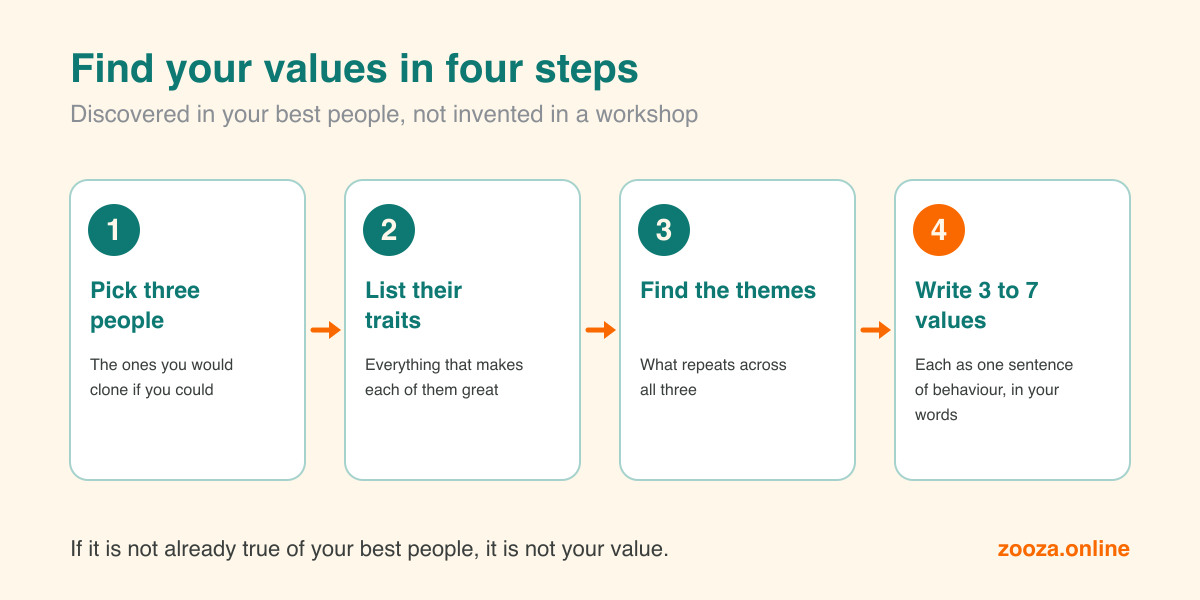
- Pick three people you would clone if you could, the ones whose departure would hurt most. Founders count.
- List their traits. Everything that makes each of them great, in plain words: takes charge, never makes a parent feel stupid, learns something new every term.
- Find the themes that repeat across all three.
- Write three to seven values, closer to five is typical according to EOS, and ten is too many. Each one gets a sentence or two describing behaviour, in your own language.
One test catches most bad values: if it is not already true of your best people, it is not your value. It might be a goal. Goals are fine. They just do not belong on this list.
We wrote about this exercise in 2024 in our guide to finding and keeping lecturers, with one warning worth repeating: the aim is not a team of copies of the owner. Different people can share values and still complement each other.
Step 2: write each value as behaviour
A value that you cannot observe cannot be scored, hired for or defended in a difficult conversation. So every value needs a short description of what it looks like in practice.
Here is an example based on the real values of a children’s course network we work with, lightly edited so that it stays anonymous:
- Expertise and curiosity. We know our craft and keep learning it. When each of us improves, the whole project moves forward.
- Teamwork and respect. Everyone in the team gets room to grow. We put the shared goal ahead of personal ego, and we would rather move forward together than alone. The business grows only as fast as its people.
- Leadership. We lead our daily work the way we lead children in class: we take responsibility, show the way and tackle problems instead of passing them on.
- Maturity. Experience helps us understand each other, our clients and the children. We own our decisions and learn from both mistakes and successes. Others can lean on us.
- Doing our best. We go deep and care about the result. Perfection is out of reach, and that does not stop us from giving the best that is possible right now.
- Authenticity and acceptance. We speak to each other with respect and warmth, and openly. Everyone can be themselves.
Notice what makes these work. Each one could only have been written by people who run children’s classes (“the way we lead children in class”). Each describes behaviour you can see. And together they describe a recognisable kind of person.
Step 3: score the team you already have
This is the step most owners skip, and the one that changes things.
Take every person in the team, including the ones you like, and rate them against every value:
- + they live it consistently,
- +/− sometimes they do, sometimes they do not,
- − they do not.
EOS calls this the People Analyzer and suggests a bar: with five values, three pluses, two plus/minuses and no minuses (EOS Worldwide). The exact bar is yours to set, but set it before you start scoring.
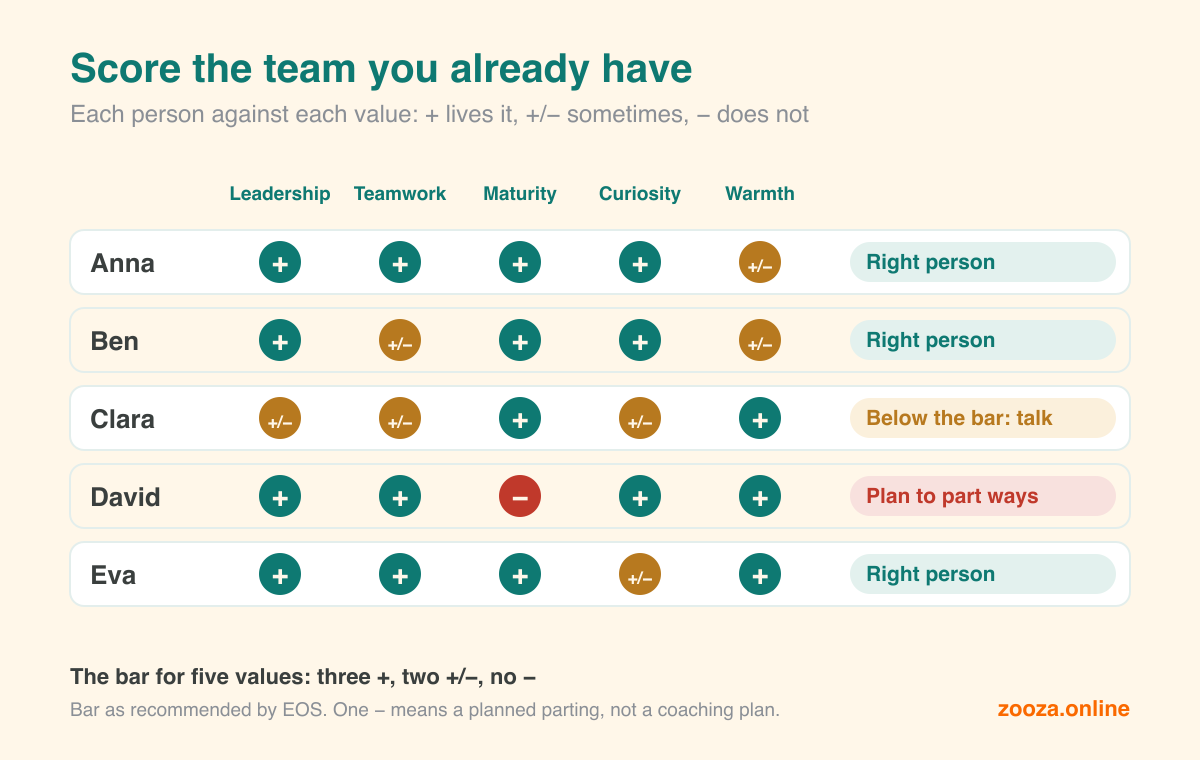
Our rule of thumb on reading the result is simple. A +/− is fine. Nobody is perfect, and a +/− is a conversation, a concrete example and a date to look again. A − on any value means planning to part ways. Not a coaching plan, not “let’s see after the summer”. Character rarely changes in the short or medium term, and hoping it will is how a bad fit stays for three years.
Do the scoring with a co-founder or a manager if you have one, separately at first and then together. Where your ratings differ, you have found something worth talking about.
Step 4: hire by them
Once the values exist, hiring gets faster, not slower, because you know what you are looking for before the first interview.
Put them in the job ad. Not as a list of words, but as a short paragraph of what working with you is like. The people who recognise themselves apply. Some of the others will not, which saves you both time.
Ask for examples, not opinions. For each value, prepare one question that starts with “Tell me about a time…”. With the values above, that might be:
- Expertise and curiosity: “What have you learned in the last three months, and how did you go about it?”
- Teamwork and respect: “Tell me about a time you put the team’s goal ahead of your own.”
- Leadership: “Tell me about a problem nobody owned that you took charge of.”
- Maturity: “Tell me about a decision that went wrong. What did you do next?”
- Doing our best: “Show me something you made that you are proud of. What would you improve now?”
- Authenticity and acceptance: “Tell me about a time you had to tell a colleague something uncomfortable.”
Watch the values in action. An audition class, a shadow day or the first weeks of a trial period show you how someone behaves with a nervous child, a cross parent and a colleague who needs help. Score them against the values at the end, the same way you scored your team.
Use the same values for partners. When you choose a franchisee or a location lead, the values matter even more, because you will see that person far less often. Our guide to finding the person who will run your next location goes through where to look and how to select.
Step 5: act when someone does not fit
Here is the uncomfortable part, and the reason most values end up on a wall instead of in decisions.
When one person does not fit, the team sees it long before the owner acts. They see who is late, who gossips, who leaves the mess for others. Every week you wait, they learn what your values really are: whatever you tolerate. Your best people notice first, and some of them leave. The problems that follow, from cut corners to a split team, usually cost more than the vacancy would have.
So decide early. Use the trial period for what it is for. When someone scores a − and nothing changes after an honest conversation, part ways, respectfully and in line with your local employment law, and explain to the team what happened without gossip. And do not let a mismatch move further up: a person who does not fit as an assistant should not become the next location lead.
The rule applies to the owner too. If the founders do not live the values, nobody else will.
Step 6: use them everywhere else
Values that only appear in hiring fade. Bring them into the rest of the year:
- Onboarding. Explain each value with a real story from your own business.
- Reviews. Start every review with the values, before skills and numbers. EOS does exactly that (EOS Worldwide).
- Recognition. When someone lives a value well, say so, in front of the team, and name the value.
- New locations and partners. A new location runs on the same values as the first one, or it slowly becomes a different business with your logo on it.
Common mistakes
- Too many values. Ten values are a list nobody remembers. Three to seven, ideally around five.
- Generic words. If a value could hang on any company’s wall, rewrite it until it could only be yours.
- Aspirations dressed up as values. If it is not already true of your best people, it is a goal.
- Owner exempt. Values the founders do not live are worse than none.
- Scoring once. Score the team again every six or twelve months. People grow, and some do not.
- Copying someone else’s. The example above works because it came from a real team. Use it for inspiration, not as a template.
A checklist for this month
- We picked the three people we would clone and listed their traits.
- We have three to seven values, each with a sentence of behaviour.
- We scored everyone on the team, owners included, with +, +/− and −.
- Every − has a plan, and every +/− has a conversation and a date.
- Our job ad describes the values in plain language.
- We have one “Tell me about a time…” question per value.
- We score candidates against the values after an audition class or shadow day.
- We use the same values to choose franchisees and location leads.
Where to go next
Values decide who you hire. The rest of the system decides what that person can achieve. If you are growing, read how to find the person who will run your next location, our older piece on why every course business needs both a visionary and someone who executes, and, for franchisors choosing software for a network, what franchisors ask before they buy a system.
Then go back to the instructor the children adore, the one who is late again on Saturday. Score them honestly. Your team already has.